

When you start looking for a magnesium supplement, the label can get too confusing.
You may see magnesium glycinate, magnesium bisglycinate, buffered magnesium, magnesium oxide, or several of these names on the same shelf. The amount of magnesium is usually printed in large numbers, but the form of magnesium gets much less attention.
That can make choosing a supplement harder than it needs to be.
If you are trying to understand the difference between magnesium glycinate and bisglycinate, or wondering what “buffered” means, only the name on the front of the supplement bottle is not going to help you.
In this blog, we will discuss what magnesium is, what magnesium glycinate, bisglycinate, and buffered magnesium are, and how these forms differ.
What Is Magnesium?
Magnesium is an essential mineral that helps with different functions in the human body, including normal muscle and nerve function, energy metabolism, protein synthesis, as well as the maintenance of bones.
Your body gets magnesium through food. Nuts, seeds, legumes, whole grains, and some green vegetables can contribute to your daily intake.
Even with a varied diet, magnesium intake can differ from person to person. Dietary habits, age, and certain health conditions can all affect this status.
That is one reason magnesium supplements are widely used. The question for a supplement buyer is then more specific: which form should you choose?
Why Are There Different Types of Magnesium Supplements?
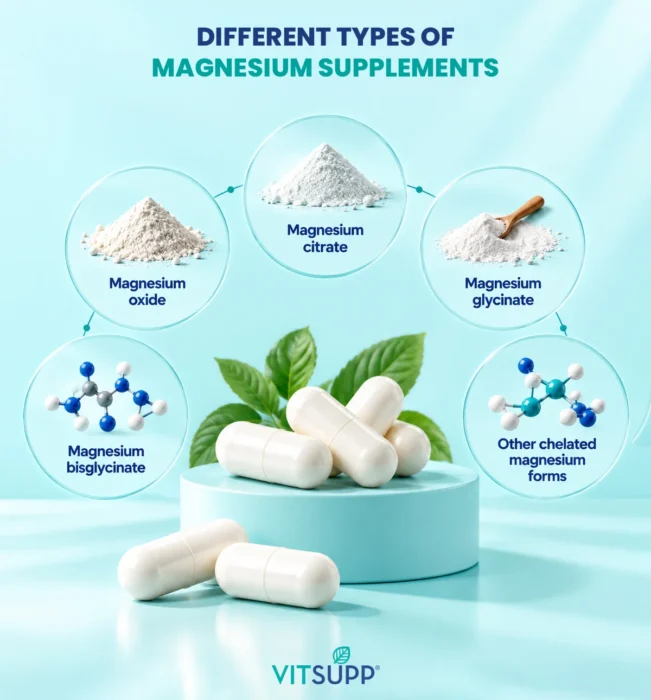
Magnesium does not usually appear in a supplement as plain elemental magnesium. It is attached to another compound or salt, and that combination affects the characteristics of the supplement.
You may come across various types of magnesium, such as:
- Magnesium oxide
- Magnesium citrate
- Magnesium glycinate
- Magnesium bisglycinate
- Other chelated magnesium forms
These forms can differ in their chemical structure, elemental magnesium content, and how well they are tolerated.
This is why comparing magnesium supplements only by the number of milligrams on the label can give you an incomplete picture.
What Is Magnesium Glycinate?
Magnesium glycinate is a commonly used name for magnesium associated with glycine.
Glycine is an amino acid. In chelated magnesium products, magnesium is assossiated to glycine, which is one reason these products are often described as magnesium glycinate chelate.
You may also see “magnesium glycinate” used as a general product name even when the technical ingredient name on the specification is magnesium bisglycinate.
That brings us to a common source of confusion.
What Is Magnesium Bisglycinate?
Magnesium bisglycinate is a more specific name for a magnesium-glycine chelate in which magnesium is associated with two glycine molecules.
The term “bisglycinate” therefore tells you something about the chemical form of the ingredient.
This is useful when reading supplement labels because two products can use the word “glycinate” while having different overall formulations.
For that reason, the full ingredient list matters more than a single word on the front of the bottle.
Magnesium Glycinate vs Bisglycinate: Are They Different?
In everyday supplement marketing, the terms are often used interchangeably. In technical terms, “bisglycinate” is more specific.
So if you are comparing magnesium glycinate vs magnesium bisglycinate, the important thing to check is how the manufacturer defines the ingredient and what else is present in the product.
A product labelled magnesium glycinate may be based on a bisglycinate chelate. Another product may use the same general naming but include additional magnesium salts.
The label alone may not answer that question.
That is why it is worth checking the complete ingredient panel and, where available, the manufacturer’s product documentation.
What Does “Buffered Magnesium” Mean?
The term “buffered” can sound technical, but the idea is fairly straightforward.
A buffered magnesium product may contain magnesium bisglycinate or another chelated form alongside another magnesium salt. Magnesium oxide is commonly used for this purpose.
Why add another magnesium source?
One reason is that different magnesium compounds contain different amounts of elemental magnesium by weight. Using a combination can change the amount of elemental magnesium supplied by a serving.
For the consumer, that means the word “glycinate” on a label is worth checking more closely. Look at the full ingredient list rather than assuming that every product with that word contains only magnesium bisglycinate.
Magnesium Glycinate vs Bisglycinate vs Buffered
The word “buffered” is where label reading becomes especially important.
Buffered magnesium generally refers to a formulation in which a chelated magnesium ingredient is combined with another magnesium source. Magnesium oxide is one example that may be used in buffered formulations.
The exact formulation can vary between products, so “buffered” does not tell you everything about the product’s quality or how much of each magnesium source it contains.
Here is a simpler comparison:
| Feature | Magnesium Glycinate | Magnesium Bisglycinate | Buffered Magnesium |
|---|---|---|---|
| What the name refers to | A common name used for magnesium associated with glycine | A more specific magnesium-glycine chelate | A formulation containing a chelated magnesium source plus another magnesium source |
| Chelated form | Can refer to a chelated form | Yes, when referring to magnesium bisglycinate chelate | May contain a chelated form |
| Additional magnesium source | Depends on the product | Depends on the product | Usually present |
| Magnesium oxide | May or may not be included depending on formulation | May or may not be included depending on formulation | Commonly used as the additional magnesium source |
| What you should check | Full ingredient panel | Ingredient form and elemental magnesium | Which additional magnesium source has been used |
| What the name tells you | Limited information | More specific information about the magnesium form | Describes a formulation approach |
There is an important distinction here. A buffered product is not automatically a poor product. The term describes how the magnesium has been formulated. To understand what you are actually taking, you need to look at the ingredients and the amount of elemental magnesium.
Chelated vs Non-Chelated Magnesium: What’s the Difference?
The form of magnesium you choose can affect how your body handles the mineral. In a chelated form, magnesium is bound to another molecule. In magnesium bisglycinate, it is bound to glycine, an amino acid.
| Magnesium Bisglycinate Chelate | Magnesium Oxide | |
|---|---|---|
| Form | Magnesium bound to glycine | Magnesium salt |
| Chelation | Yes | No |
| Bioavailability | Research suggests good absorption | Relatively low absorption |
| Elemental magnesium | Lower per gram of compound | Higher per gram of compound |
| Digestive tolerance | Generally well tolerated | May cause digestive discomfort at higher intakes |
Research comparing magnesium chelates with magnesium oxide has found greater absorption for chelated forms in some settings.
This is why VitSupp uses unbuffered magnesium bisglycinate chelate. The formulation provides magnesium in a chelated form, without adding magnesium oxide.
Magnesium Absorption: Does the Form Matter?
Yes, the form of magnesium can matter.
Different magnesium compounds have different characteristics. However, absorption is not something you can reliably judge from the product name alone.
The amount of elemental magnesium, the particular compound used, the dose, and individual digestive factors all have a role.
This is also why phrases such as “best absorbed magnesium” should be treated carefully. A manufacturer would need appropriate evidence to support a specific comparison.
For someone choosing a supplement, it is more useful to ask a few practical questions:
- What form of magnesium is being used?
- How much elemental magnesium does the serving provide?
- Does the product contain more than one magnesium salt?
- Is the formulation clearly declared?
- Is there information about quality testing?
Those questions tell you more than a large number printed on the front of a bottle.
Magnesium Benefits and Magnesium Deficiency
Magnesium is involved in many of the processes your body carries out every day, so getting enough matters.
When your intake is too low, some of these normal functions may be affected.
Magnesium Deficiency
- Possible symptoms: Muscle cramps, tiredness, and weakness can occur with magnesium deficiency, but these symptoms aren’t specific to low magnesium and may have other causes.
- Look at your overall intake: Your diet is an important starting point when considering whether you’re getting enough magnesium. Your health history may matter too.
- Don’t self-diagnose: If symptoms persist or you think you may have a deficiency, speak with a healthcare professional before starting a supplement.

Magnesium Benefits
- Muscle and nerve function: Magnesium helps your muscles and nervous system work normally.
- Energy metabolism: Your body uses magnesium in the processes involved in producing and managing energy.
- Bone health: Magnesium contributes to maintaining normal bones.
- Protein synthesis: Magnesium also plays a role in making the proteins your body needs for normal maintenance.
Magnesium Bisglycinate Side Effects and Tolerability
Here are some common side effects of magnesium bisglycinate that you should be aware of:
- Digestive side effects: Magnesium supplements can sometimes cause loose stools, nausea, or abdominal discomfort, particularly when taken in higher amounts.
- Individual tolerance varies: Your response can depend on the amount you take, your overall magnesium intake, and how your body tolerates the supplement.
- Magnesium bisglycinate and tolerability: Magnesium bisglycinate is a chelated form of magnesium and is commonly chosen for regular supplementation because it is generally considered gentle on the digestive system.
- Choose the dose based on your needs: Your total magnesium intake matters. Consider the magnesium you get from food alongside any supplement you take.
- More isn’t always better: Taking a larger amount doesn’t necessarily provide greater benefits. Staying within an appropriate dose is important for regular use.
How to Choose a Magnesium Supplement
If you are comparing magnesium supplements, spend a little time with the back of the bottle.
- Check the magnesium form: Look for the specific form of magnesium. If it says “magnesium glycinate”, check whether it is actually magnesium bisglycinate.
- Check the elemental magnesium: Look at how much actual elemental magnesium the serving provides, rather than the total weight of the magnesium compound.
- Read the complete ingredient list: Check whether other magnesium salts are included. If the product says “buffered”, check which additional magnesium source has been used.
- Look for unnecessary blends: If a product contains multiple magnesium salts, check what they are and why they have been included.
- Check quality information: Look for clear details about testing and manufacturing. If a brand makes a testing claim, check what was actually tested.
What Does This Mean for VitSupp?
The label-reading approach above is the reason VitSupp chose to make its Magnesium Bisglycinate formulation clearly defined.
VitSupp Magnesium uses magnesium bisglycinate chelate in an unbuffered formulation. The formulation has no added magnesium oxide and no mixed magnesium salts. It is supplied in a vegetarian HPMC capsule and does not use artificial colours or preservatives.
The purpose of calling it “unbuffered” is simply to tell you what is in the formulation. It helps distinguish the product from formulations that combine a chelated magnesium ingredient with another magnesium source.
VitSupp also has finished-product testing, batch-wise, for specific quality parameters. The available testing covers elemental magnesium, heavy metals, microbiological parameters, aflatoxins, and capsule disintegration.
This level of precision is useful when you are comparing supplements. You should be able to separate a formulation claim from a testing claim.
Conclusion:
Magnesium supplements can look very similar at first glance, but the details of the formulation can be quite different.
When comparing magnesium glycinate, magnesium bisglycinate, and buffered magnesium, start with the ingredient list. Check the exact magnesium form, the elemental magnesium amount, and whether another magnesium salt has been added.
For consumers who prefer a clearly defined formulation, VitSupp Magnesium Bisglycinate uses an unbuffered magnesium bisglycinate chelate formulation with no added magnesium oxide or mixed magnesium salts, along with finished-product testing for specified quality parameters.
Explore VitSupp‘s scientifically designed formulations with the information you need to make a choice that suits your everyday wellness routine.
Frequently Asked Questions
1. Is Magnesium Glycinate The Same As Magnesium Bisglycinate?
These two terms are often used interchangeably on supplement labels. But magnesium bisglycinate is the more specific name for a magnesium-glycine chelate. If a product is labelled magnesium glycinate, you need to check the ingredient details to see exactly what form has been used.
It is also useful to check whether other magnesium salts are present. These two products can use similar wording on the front of the bottle and still have different formulations.
2. What Is Magnesium Bisglycinate?
Magnesium bisglycinate is basically a chelated form of magnesium. In this case, magnesium is associated with glycine. It is commonly used in magnesium supplements and is often selected for its formulation characteristics and digestive tolerability.
When comparing magnesium bisglycinate products, look at the elemental magnesium provided per serving and the complete ingredient list. The term “bisglycinate” tells you about the magnesium form, but it does not by itself tell you whether the product contains other magnesium sources or how the finished supplement has been formulated.
3. What Is Buffered Magnesium?
Buffered magnesium generally refers to a formulation that combines a chelated magnesium ingredient with another magnesium source. In this case, magnesium oxide is commonly used as the additional source.
Therefore, the exact formulation can differ between products, so the word “buffered” alone does not tell you how much of each magnesium source is present. If you are comparing buffered magnesium with magnesium glycinate or bisglycinate, check the complete ingredient panel and the amount of elemental magnesium rather than relying only on the product name.
4. What Is Chelated Magnesium?
Chelated magnesium refers to magnesium that has been bound to another molecule or compound. In magnesium bisglycinate, magnesium is associated with glycine, which makes it a chelated form. You may see terms such as “magnesium glycinate chelate”, “magnesium bisglycinate chelate” or “Mg chelate” on supplement labels.
These terms describe the form of the ingredient, but they do not tell you everything about the finished product. The full ingredient list and elemental magnesium amount are still important when comparing supplements.
5. Which Magnesium Is Better For Absorption?
Magnesium bisglycinate is a chelated form of magnesium, while magnesium oxide has relatively poor bioavailability. Research on magnesium chelates suggests they can be better absorbed than magnesium oxide in certain settings. In a small study of patients with ileal resection, overall magnesium absorption did not differ significantly between magnesium diglycinate and magnesium oxide, although diglycinate showed greater absorption in a subgroup with the poorest oxide absorption.
So, magnesium bisglycinate can be a sensible choice for regular supplementation, although direct evidence specifically proving it is always better absorbed than oxide remains limited.
6. What Is Elemental Magnesium?
Elemental magnesium is the actual amount of magnesium supplied by a supplement, separate from the other parts of the magnesium compound. For example, magnesium bisglycinate contains magnesium as well as glycine, so the total weight of the compound is higher than the amount of elemental magnesium it provides.
When comparing magnesium supplements, elemental magnesium is therefore the more useful figure to examine. A higher weight of the magnesium compound does not necessarily mean that the supplement provides more elemental magnesium.
7. Can Magnesium Bisglycinate Cause Side Effects?
Magnesium bisglycinate is generally well tolerated, but it can still cause digestive discomfort in some people, especially at higher supplemental intakes. Loose stools, nausea, or abdominal discomfort may occur. Also, people with kidney disease should speak with their doctor before taking magnesium supplements.
Your response can also depend on the dose and your overall magnesium intake. If you experience persistent discomfort, stop and speak with a healthcare professional. If you take medications regularly, check with your doctor before starting magnesium bisglycinate.
8. What Are The Symptoms Of Magnesium Deficiency?
Magnesium deficiency can affect normal body functions, but symptoms such as tiredness, muscle cramps or weakness are not specific to magnesium deficiency and can have other causes. A suspected deficiency should therefore be considered alongside your diet, medical history and other relevant factors.
If you have persistent symptoms or believe your magnesium intake may be inadequate, speak with a healthcare professional rather than assuming that a supplement will address the underlying cause.
9. How Much Magnesium Do You Need Each Day?
According to the National Institutes of Health Fact Sheet your magnesium requirement depends on factors such as age and sex: Men (19–51+ years): 400 to 420 mg per day, whereas women (19–51+ years): 310 to 320 mg per day. Magnesium can come from food as well as supplements, so the amount you need to obtain from a supplement will depend on your overall intake. Foods such as nuts, seeds, legumes, whole grains, and some green vegetables can contribute magnesium to your diet.
If you are considering a higher-dose supplement, particularly because of a suspected deficiency, it is sensible to discuss the appropriate amount with a healthcare professional.
10. How Should You Choose A Magnesium Supplement?
Start by checking the form of magnesium and the amount of elemental magnesium per serving. Then read the full ingredient list to see whether the product contains additional magnesium salts. If the label says “buffered”, check which additional magnesium source has been used.
You can also look for information about finished-product testing and other formulation details. A clearly declared ingredient list makes it easier to compare products and understand what you are actually taking.