

The hectic pace and stress of modern life often make us overlook growing health problems and symptoms. Do you dismiss symptoms like sleeping woes, chronic fatigue, and muscle soreness as results of overwork and stress? The root cause can be a nutritional deficit, and your body may be coping with a magnesium shortfall.
ResearchGate data indicate that approximately 31% of the global population, or 2.4 billion people, do not consume adequate amounts of magnesium. The reasons are numerous, including poor dietary habits, genetic factors, and soil nutrient loss. The reality is your body needs a certain amount of magnesium for muscle recovery, sleep, and many other physiological functions, including hormone functionality.
Adhering to a magnesium-rich diet may not be easy, and a regular deficit only intensifies your problems. Consuming a magnesium supplement can help, but you must choose the right one. Choose a supplement with a balanced, well-tested formulation for optimal magnesium absorption.
VitSupp Magnesium Bisglycinate Chelate – Unbuffered is designed to support better sleep, stress balance, and muscle recovery — in a gentle, well-formulated way suitable for a wide range of users. It is a vegetarian-friendly magnesium supplement with a focused formulation, nothing added, nothing hidden.
In this blog, we’ll dive deep into the science behind magnesium and cover its key benefits for sleep, stress reduction, and muscle recovery. We’ll also learn why magnesium bisglycinate is the most effective form for such needs and how to choose the right supplement with it.
What is Magnesium, and why does its Deficiency Cause Health Issues?
An essential mineral, Magnesium is responsible for managing over 300 biochemical processes in your body. It directly affects your sleep, stress levels, and muscle function. Your body also needs it to maintain normal heart function and blood sugar levels. When you do not intake enough Magnesium, the result is different health complications. You will cope with muscle soreness, experience more stress, and sleeping problems will creep in.
Magnesium is what your body needs for hormonal balance, too. For example, it helps maintain melatonin, the hormone your body needs for sleep. It also supports stress response. When you develop a magnesium deficit, these hormones cannot function properly, adding to several physical and mental symptoms. So, you need enough magnesium for better sleep, stress reduction, and staying fit.
Magnesium Deficiency and Its Effect on Sleep, Stress, and Muscles
Low magnesium levels can affect your ability to relax and recover, and stay energetic. Here’s how:
1. Sleeping Woes – Magnesium helps control the levels of melatonin, the sleep hormone, and soothes the nervous system. Low magnesium levels may contribute to sleep disturbances in some individuals.
2. Stress and Anxiety – Magnesium and anxiety are deeply linked. This key mineral helps mitigate hormonal imbalance. Low magnesium intake contributes to excessive cortisol production, and that paves the way to increased stress and anxiety.
3. Muscle Recovery – Your body needs magnesium for muscle recovery. It helps your muscles relax and reduces cramps. If you do not get enough magnesium, recovering after injuries or even a long workout session will be tougher and slower.
When you do not get enough magnesium through food, use a suitable magnesium supplement. But the key is using the products with the best magnesium for sleep, muscle relaxation, and stress management- namely, magnesium bisglycinate.
Magnesium Benefits for Better Sleep
Without proper, quality sleep, you cannot stay healthy, no matter how much you work out or what diet you try. While sleep deficiency can be caused by many factors, one big but overlooked factor is magnesium deficiency. Without enough magnesium, your nerves stay tense, and dozing off becomes harder.
How Does it Work?
Let us see why the human body needs magnesium for sleep. This essential mineral has a calming effect on the body, especially the nervous system. It plays a role in pathways involved in melatonin regulation, a hormone that controls your sleep-wake cycle. NLH research data shows that using magnesium bisglycinate for sleep can be beneficial. Some studies suggest magnesium supplementation may support sleep quality and help reduce sleep latency in certain populations.
Now, you must be careful about picking the right form of magnesium to get better sleep and relax tired muscles, etc. Start using a supplement containing magnesium bisglycinate. This type is highly bioavailable, so it is absorbed more effectively by your body. Its chelated structure may support better absorption and improved tolerance compared to some other forms. It does not cause strong laxative reactions, common with forms like magnesium oxide.
Magnesium for Stress and Anxiety Management
Stress and anxiety have become a part and parcel of modern life. Prolonged stress exposure results in the development of different health issues. In fact, some of your existing health issues can get aggravated. This also takes a toll on your fitness and immunity levels. You can be stressed for many reasons, including a magnesium deficit.
How Does it Work?
Magnesium is a key mineral for nerve relaxation in your body.
1. This mineral helps control neurotransmitters or chemical messengers in the brain that affect the way you feel or think. Low magnesium levels can affect the hormonal balance, as per key study findings. This makes you fatigued and stressed, and you get irritated easily.
2 . Magnesium also helps fine-tune the system that affects your stress response. A lack of magnesium absorption makes it overactive, adding to a hormonal imbalance. If this goes on, you get into a recurring cycle of stress and anxiety. The result? Your mental and overall well-being takes a hit.
3. If you experience elevated stress, using a magnesium supplement can help. This has been backed by several studies, too. This mineral helps improve the production of a neurotransmitter called GABA (gamma-aminobutyric acid), vital for relaxing the nerves under stress. Magnesium plays a role in supporting the body’s stress response system, along with calm nerves.
It’s time you choose a magnesium bisglycinate supplement for stress management. VitSupp’s high-quality, non-buffered magnesium bisglycinate fits the bill perfectly here. You get chelated magnesium bisglycinate in easy-to ingest capsule form.
Learn how this essential mineral supports your body in our guide to magnesium as a key nutrient for energy, muscles, and health.
Magnesium for Muscle Recovery
You can develop sore muscles in many situations. This can happen to athletes and sportspersons from time to time. Muscles get sore after strenuous workout sessions, too. Of course, you can get injured, and that can make the muscles sore. Whatever the reason for muscle injury and soreness is, using magnesium for muscle relaxation and cramps can help.
How Does it Work?
Magnesium has an active role in protein synthesis in the human body. Magnesium helps muscles release and relax after contracting, and that helps you get relief from painful spasms and tightness. This mineral also supports the body’s natural anti-inflammatory processes after muscle cramps and injuries. You get relief from lingering soreness. Besides, it supports muscle function and recovery processes following physical activity.
Some studies suggest magnesium supplementation may help reduce post-exercise muscle soreness. If you are coping with muscle soreness and cramps after workouts or even after daily chores, choose magnesium for muscle pain relief. However, make sure you choose a supplement with magnesium bisglycinate.
Taking a magnesium bisglycinate supplement can help you get better results in muscle pain and cramps. Made with a highly bioavailable form, it gets absorbed quickly, supports muscle relaxation and recovery, sans side effects like stomach upset.
Can You Get Enough Magnesium From Diet Alone?
You may feel it is possible to get enough magnesium from foods. In reality, it is increasingly difficult. Magnesium is naturally present in a wide range of foods. Following a well-balanced diet can help you reach your daily requirements. Here is what a magnesium-rich diet typically looks like:
- Leafy greens – Spinach, kale, and Swiss chard are among the best dietary sources of magnesium.
- Nuts and seeds – Almonds, cashews, pumpkin seeds, and sunflower seeds are rich in magnesium. You can include these in everyday meals and snacks.
- Other whole foods – Legumes, whole grains, dark chocolate, avocado, and bananas are also good sources of magnesium.
However, even a diet rich in these foods may not be enough to meet daily needs. The main reasons are:
- Soil depletion – Decades of intensive farming have reduced the magnesium content in soil. This means that even fresh vegetables and grains contain less magnesium than they did in the past.
- Modern food processing – Refining and processing remove a large portion of naturally occurring magnesium. White bread, polished rice, and packaged foods retain a frugal amount of the mineral compared to their whole-food counterparts.
So, relying on diet alone may not be enough to meet your body’s magnesium needs. Using a balanced magnesium supplement can help bridge the gap, one with a bioavailable form and a study-backed formulation.
Who Is Most Likely to Benefit From Magnesium Support?
Magnesium deficiency does not discriminate, but certain lifestyles and habits make you more vulnerable than others. You may need magnesium supplementation if you fall into one or more of these groups:
- High-stress lifestyles – Chronic stress actively reduces magnesium reserves in your body, creating a vicious cycle of stress and deficiency. It is hard to break without balanced supplementation.
- Athletes and fitness seekers – Intense physical activity increases magnesium loss through sweat and urine. Without replenishment, you experience muscle cramps, slower recovery, and fatigue.
- Poor sleep patterns – If you struggle to fall asleep or stay asleep, low magnesium may be an underlying reason. Then you may need additional intake.
- High caffeine usage – Caffeine is a diuretic that increases magnesium excretion through urine. Drinking several cups of coffee may add to magnesium deficiency.
- Reduced green vegetable usage – Leafy green veggies like spinach and kale are well-known dietary sources of magnesium. Low vegetable intake makes it harder to meet your daily magnesium requirements through food alone.
Do you relate to one or more of these conditions? Then, using a magnesium bisglycinate supplement may be useful.
If you suspect low magnesium levels are affecting your sleep or energy, read our guide on modern lifestyle and magnesium deficiency.
What Type of Magnesium Should You Choose and Why?
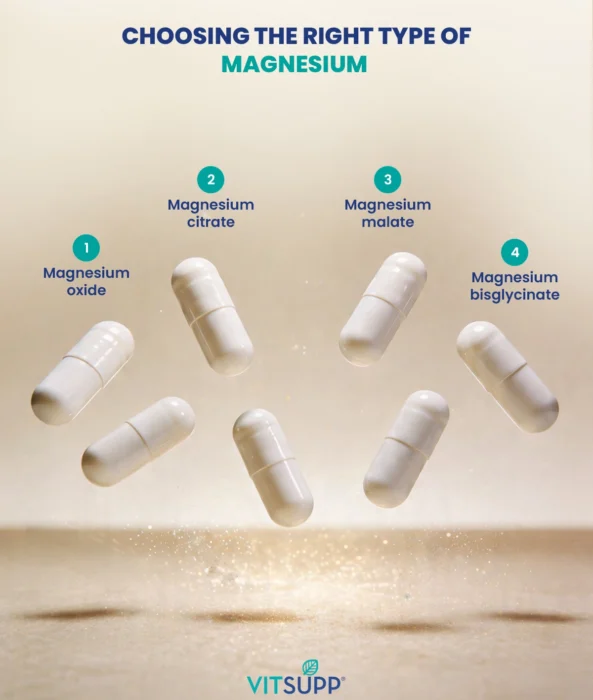
Magnesium health benefits for issues like sleep, muscle recovery, and stress are clear. But it is also important that you choose the right type of magnesium for muscle recovery and other needs. You will find magnesium supplements with the mineral used in different forms. Not all of them are very effective or safe, and these are things the industry won’t tell you.
Let’s have a quick look:
- Magnesium Oxide – The cheapest and most common form of magnesium, lower bioavailability ( approx 4%) compared to chelated forms; often used for digestive support.
- Magnesium Citrate – Used mostly for digestion and constipation relief, it’s good for digestion. But its strong laxative effect makes it unsuited for people seeking better sleep.
- Magnesium Malate – It suits people seeking relief from muscle soreness and fatigue. However, it won’t be ideal for those needing stress reduction or better sleep.
- Magnesium Glycinate – A form where magnesium is bound to glycine. It is generally well-absorbed and commonly used for relaxation and sleep support.
- Magnesium Bisglycinate (Chelated Form) -A more precise form where magnesium is bound to two glycine molecules (true chelation). Magnesium bisglycinate is a fully chelated form, meaning it is structurally designed for better absorption and tolerance. Because of this, magnesium bisglycinate is considered one of the most bioavailable and gentle forms of magnesium. This structure:
- Improves stability
- Enhances absorption
- Reduces chances of digestive discomfort
- It is especially suitable for Sleep support, Stress and nervous system balance and Daily long-term supplementation.
Want to understand how magnesium supports your entire body beyond sleep and recovery?
Check out its role in digestion and gut health → https://www.vitsupp.com/blog/magnesium-for-digestion-gut-health/
Here’s A Quick Comparison of The Available Magnesium Types
| Magnesium Form | Bioavailability | Ideal For | Pros | Cons |
|---|---|---|---|---|
| Magnesium Oxide | Low | Occasional constipation relief | Very inexpensive, widely available | Poor absorption, high likelihood of digestive discomfort, not suitable for daily supplementation |
| Magnesium Citrate | Moderate | Short-term constipation relief | Better absorption than oxide, commonly used | Can act as a laxative, may cause loose stools or discomfort, not ideal for sleep/stress |
| Magnesium Malate | Moderate | Muscle fatigue, energy production | May support energy production, better tolerated than oxide | Not ideal for relaxation or sleep-focused use |
| Magnesium Glycinate (Often Buffered) | High | Sleep, stress, general supplementation | Well-absorbed, gentle on stomach, supports relaxation | Quality varies across brands, may not always be fully chelated |
| Magnesium Bisglycinate – Buffered | Variable | General supplementation (label-driven) | Higher “elemental magnesium” on label | Often mixed with magnesium oxide → reduces actual absorption and increases digestive issues |
| Magnesium Bisglycinate Chelated – Unbuffered (True Chelated) | High & consistent | Daily supplementation, sleep, stress, recovery | Fully chelated, no oxide dilution, predictable absorption, best tolerated | Premium formulation, higher cost |
Why Most Magnesium Supplements Don’t Work?
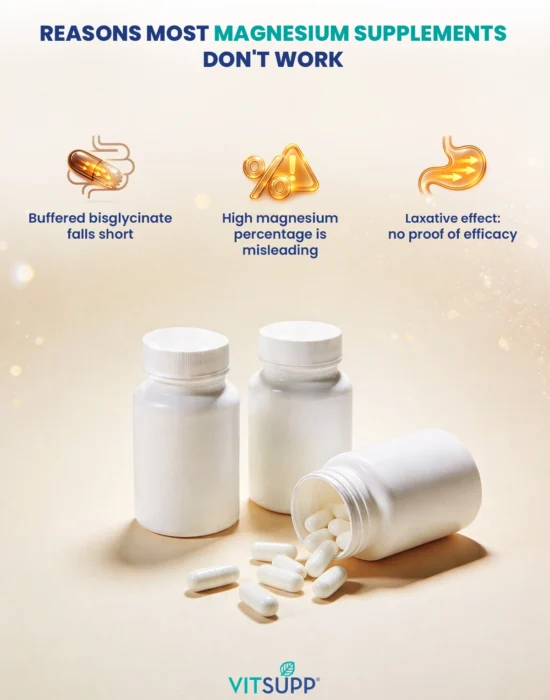
Before you start taking magnesium for stress, insomnia, or other needs, understand that not all supplements contain the formulation your body actually needs. Here’s why most OTC magnesium supplements fail to bring desired results:
1. Buffered Bisglycinate Misses the Mark
Many magnesium supplement brands claim to use magnesium bisglycinate, but in reality, they use a buffered version. They mostly mix magnesium oxide with glycine. What they offer you as a high-quality formulation is actually a trick. Magnesium oxide is known to have lower bioavailability compared to chelated forms. This means such supplements can offer your body a minuscule percentage of the mineral compared to its daily needs.
2. High Elemental Magnesium can be Misleading
When you see a magnesium supplement for sleep with high elemental magnesium listed on the label, it seems an apt product. This is misleading, as a high percentage of magnesium does not guarantee that your body will actually absorb it fully. So, supplements with magnesium oxide offer high levels of the mineral, but a poor absorption rate brings minimal health benefits. Choose magnesium bisglycinate with a significantly high absorption rate to get the desired benefits.
3. Laxative Effect Not Equivalent to Efficacy
Most magnesium supplement in the market produces a laxative effect on the body, but is that actually beneficial? Delve deeper and find the root cause. Most such supplements contain magnesium oxide. This substance causes gut discomfort and works as a laxative. But that is no proof of its efficacy or a benchmark for health benefits. With Magnesium bisglycinate, you get rid of gut discomfort while obtaining desired absorption and health benefits.
The bottom line is, when buying magnesium supplements, don’t fall for tall claims or gimmicks. If a magnesium supplement touts very high elemental magnesium, it’s a tell-tale sign of poor absorption, not strength.
A clean-label, non-buffered bisglycinate formulation can help you obtain the desired health benefits without risk factors and complications.
Why VitSupp’s Magnesium Supplement is the Best Choice for Sleep, Stress, and Muscle Recovery?
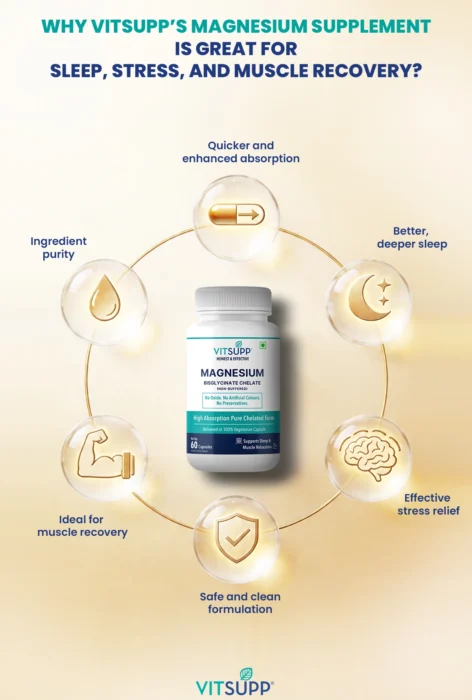
Not all magnesium supplements are equally effective for sleep, stress management, and muscle recovery. VitSupp’s Magnesium Bisglycinate stands apart due to its true chelated, non-buffered formulation, designed for consistent absorption, safety, and long-term use.
Let’s explore the VitSupp magnesium bisglycinate capsule benefits offered by this supplement:
1 Superior Absorption with True Chelation
VitSupp uses magnesium bisglycinate in its true chelated form, where magnesium is bound to two glycine molecules. This structure:
- Improves stability
- Enhances absorption
- Supports efficient delivery to cells
Unlike many products, this formulation is completely unbuffered, meaning:
- No dilution with magnesium oxide
- No compromise on absorption
2 Clean, Transparent & Thoughtful Formulation
VitSupp Magnesium is designed with only what is necessary:
- True chelated, non-buffered magnesium bisglycinate
- No magnesium oxide or hidden blends
- No artificial preservatives, colors, or fillers
- 100% vegetarian HPMC capsules
- Suitable for vegans
Every ingredient has a purpose — nothing extra.
3 Better Absorption for Desired Efficacy
VitSupp’s magnesium bisglycinate supplement offers one of the highest absorption rates available. The magnesium bisglycinate in its formulation is bound to an amino acid for easier absorption inside the body. It is ideal for muscle recovery, better sleep, and stress relief.
4 Deeper, Peaceful Sleep
Forget the nights of tossing relentlessly on the bed after trying our clean-label, non-buffered magnesium bisglycinate. Its high-quality magnesium bisglycinate supports healthy melatonin levels in your body. It relaxes the muscles and nerves, helping you fall asleep fast. There will be no gastrointestinal discomfort.
5 Effective Stress Reduction
Magnesium balances the stress hormone, cortisol, and its deficit causes an overactive stress response. The result is recurring and intense anxiety and tension. Our magnesium bisglycinate supports the body’s natural stress response for a mood boost and hormonal balance.
6 Great for Muscle Recovery
After physical exhaustion or an injury, your body needs magnesium for muscle relaxation and recovery. This essential mineral helps reduce cramps and soreness and supports normal muscle recovery after physical exertion. Our magnesium supplement, with its superior absorption, helps the mineral reach your cells and muscles quickly. It supports recovery and helps maintain comfortable muscle function after activity.
7 Clean and Safe Formulation
You will find several magnesium supplements containing ingredients that may cause side effects or aggravate health symptoms. VitSupp’s chelated, non-buffered magnesium bisglycinate comes without any artificial preservatives, gluten, gelatin, or fillers. Based on HPMC capsules, it is also suited for vegetarians. You get a pure, useful magnesium supplement with better safety.
8 Quick and Optimal Absorption
In this single-ingredient, non-buffered magnesium bisglycinate, you get a formulation designed for absorption, not label appeal. It was developed after extensive research and third-party testing.
9 Designed for Daily Use — Not Just Label Appeal
This is a single-ingredient formulation built for function, not inflated numbers.
- No “elemental magnesium inflation”
- No marketing-driven blending
- Focus on real absorption and real outcomes
Developed through careful formulation and quality testing, this supplement is intended for consistent, long-term use you can trust.
Conclusion
Your body needs magnesium for sleep, muscle recovery, and stress management. Of course, the mineral also manages hundreds of other physiological functions. When you do not consume enough magnesium, the body may show subtle signs. Your muscles remain sore for longer after a workout and injuries. Even your mental well-being takes a hit, making you anxious and irritable.
Supporting adequate magnesium intake may help improve these concerns. But the thing is, you get such magnesium supplement benefits only when it contains the right form of the mineral. Not all magnesium supplements are formulated the same. Choosing a clean, non-buffered bisglycinate form ensures you’re prioritizing absorption and tolerance.
VitSupp’s magnesium bisglycinate supplement contains a highly effective, single-ingredient formulation, and it is safe for all types of users, including vegetarians. It comes with the assurance of GMP certification and FSSAI approval, too. What’s more, you get relief from comparing different product variants – one simple supplement is there.
Don’t let magnesium deficiency affect your sleep, stress levels, and muscle recovery. If you’re considering magnesium supplementation, choose a well-formulated bisglycinate formulation.
FAQs
1. Can magnesium deficiency worsen sleep, stress, and muscle cramps?
Yes, magnesium deficiency can significantly affect sleeping woes, stress, and cause muscle cramps. This mineral controls the functioning of melatonin, a hormone with a strong effect on the sleep cycles in your body. Without enough magnesium, your body cannot manage the hormone well, resulting in sleep disruptions or difficulty falling asleep. Magnesium also helps regulate stress response in the body. Low magnesium levels can cause excess hormone production, adding to the anxiety and stress. Besides, it aids in muscle relaxation, and so a deficit causes muscle soreness or cramps after a workout and injuries. If dietary intake is insufficient, supplementation may help support optimal magnesium levels.
2. What is the role of magnesium and melatonin in sleep?
Magnesium supports hormonal balance, including Melatonin, a hormone that is responsible for inducing sleep. Magnesium supports GABA (gamma-aminobutyric acid), a neurotransmitter that helps make your brain relax and calm. Research findings show that enough magnesium levels support the natural production of melatonin, a prerequisite for sound sleep. When you do not get the required amount of magnesium for any reason, sleeping problems crop up. Using a suitable magnesium supplement will help here. However, ensure you choose a supplement with Magnesium bisglycinate in its formulation for the desired results.
3. What are the benefits of taking a magnesium supplement at night?
Taking a magnesium supplement at night can be useful when dealing with stress and sleeping woes. Magnesium has natural calming properties that affect the central nervous system and the brain. Take a magnesium supplement at bedtime to keep the sleep hormone,melatonin, functioning well. You will then fall asleep easily. Besides, magnesium supplement benefits include a reduction in muscle cramps and spasms. With sore muscles, you may find it tough to doze off. Take the right and effective supplement for optimum magnesium health benefits, andVitsUpp’s Magnesium bisglycinate fits the bill well.
4. Can magnesium reduce high cortisol caused by stress?
Yes, Magnesium plays a role in regulating the body’s stress response, including the HPA axis. When you are exposed to stressful incidents and experiences, its level in the body shoots up. When the hormone stays high for a long time, it can hurt your overall well-being. You tend to become irritable, tense, and worn out. Magnesium helps control the production of this hormone by supporting the HPA axis. Studies have shown that using magnesium supplements can reduce high hormone levels. Of course, you have to pick a supplement with the right formulation, with Magnesium bisglycinate. It is highly bioavailable, calms nerves, and helps lower its levels.
5. What are the benefits of magnesium bisglycinate for sleep and stress?
Magnesium bisglycinate, a chelated form of magnesium, is very effective in promoting sleep and reducing stress. It has a mix of magnesium and the amino acid glycine, and that makes your body absorb this quickly. Magnesium supports pathways involved in melatonin regulation, and so it induces better sleep. It also helps activate a neurotransmitter called GABA that calms your nerves. This can be especially helpful when you deal with sleeping issues. This type of magnesium also gives relief from stress and anxiety. It effectively helps regulate stress response. When you want an effective magnesium for relaxation and mental calm, choose a single-ingredient, non-buffered magnesium bisglycinate product.
6. Can magnesium supplements help with chronic stress?
Magnesium is the mineral that helps you deal with stress better, and this is supported by several study findings, too. As magnesium helps regulate the stress response and supports the nervous system, its role in managing the body’s stress response is vital. On the other hand, when you remain stressed for long, that can reduce magnesium levels in the body. This adds to a vicious cycle, hurting overall well-being and mental health. Magnesium also helps your body produce GABA (gamma-aminobutyric acid). This important neurotransmitter helps calm the brain, reducing stress levels.
7. Which magnesium supplements are best for high cortisol?
High cortisol levels in the body keep you stressed, adding to poor mental health and a lower quality of life. For effective cortisol reduction, you must focus on increasing your magnesium intake through food and high-quality supplements. You should ideally choose a magnesium supplement containing the most bioavailable form of the mineral, namely magnesium bisglycinate. It not only helps lower stress hormone levels but also acts gently, without affecting your gut. Other forms like magnesium citrate and magnesium malate are also beneficial, but Bisglycinate is often chosen for its bioavailability and digestive comfort. It supports the nervous system and helps mitigate stress. Choose a magnesium bisglycinate supplement for the desired results.
8. How does magnesium help with muscle relaxation?
Magnesium is a natural muscle relaxant. It helps maintain the balance of calcium in muscle cells. So, your muscles contract properly and then relax afterward. When your magnesium levels are low, this process takes a hit. Then you start feeling the cramps, spasms, and discomfort. You can feel this more after a strenuous workout session or after getting injured. Magnesium supports the nervous system and sends signals to the muscles to relax by supporting GABA (gamma-aminobutyric acid) production. To get the desired results here, try consuming the most bioavailable type of magnesium – magnesium bisglycinate.
9. What is the role of magnesium in muscle cramps?
Magnesium plays a vital role in muscle function in your body. It helps muscles stay relaxed throughout. When you can’t get enough magnesium, it results in involuntary contractions. You feel cramps or spasms, especially after any intense physical activity. In fact, magnesium helps maintain the balance between calcium and potassium, two other minerals that play key roles here. If you want to take magnesium for muscle recovery, choose a supplement that comes with magnesium bisglycinate. A single-ingredient, non-buffered magnesium bisglycinate will be ideal for this.
10. What evidence supports magnesium benefits for sleep, stress, and muscle recovery?
Several clinical studies have shown that the human body needs magnesium for sleep, stress, and muscle recovery. A study published in the Journal of Research in Medical Sciences showed that using magnesium supplementation helped people with insomnia sleep better, for example. Take magnesium bisglycinate for sleep, as it gets absorbed fast and supports sleep. Other studies have also shown its role in stress reduction and muscle recovery. While results vary depending on study design and population, research suggests magnesium may support sleep and stress regulation in certain groups.






Thanks for highlighting the often-overlooked role of magnesium in sleep, stress, and muscle recovery. It’s alarming to see how widespread magnesium deficiency can be, especially with modern diets and soil depletion. Your point about the importance of choosing the right supplement formulation really resonated—absorption and bioavailability truly make a difference in how our bodies utilize nutrients.