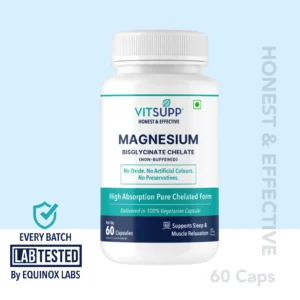
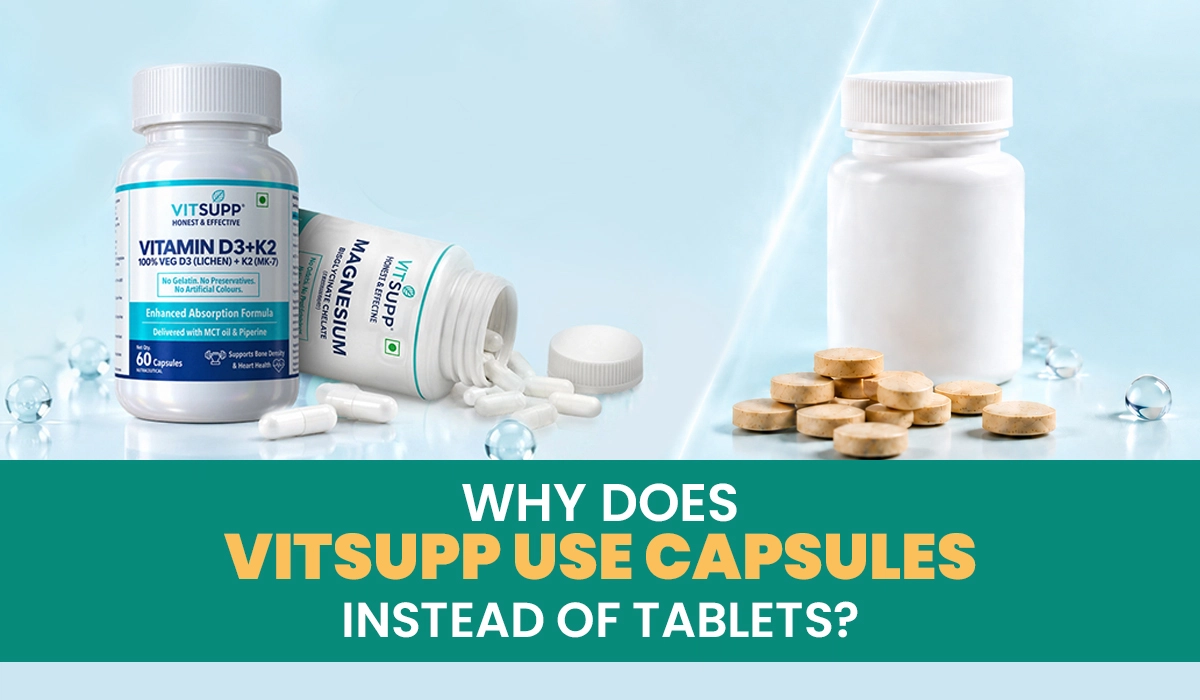
Some supplements are sold in capsule form, while others ship in tablet form. Does this difference between tablet and capsule matter from a health perspective?
It is not universally fair to say capsules are automatically “better”. Both tablets and capsules are medically accepted oral dosage forms. However, their performance depends on factors like the characteristics of the active ingredients and the way the formulation releases or dissolves. The FDA emphasizes dissolution as an important performance consideration for such oral dosage forms.
For a premium supplement brand like VitSupp, which focuses on ingredient purity and potency, choosing the capsule form is a formulation decision rather than a marketing step. This is why we use premium-quality vegetarian HPMC capsules.
In this blog, we will look into the nuances of capsule and tablet differences, learn about their use cases, and analyze why VitSupp prefers using capsule form.
Capsule vs Tablet: What are the Differences?
The main difference between a capsule and tablet is in the way ingredients are presented as a dosage form. Both are solid oral dosage forms, but their structure and manufacturing are different.
What Is a Tablet?
Brands manufacture tablets by creating a blend of active ingredients and appropriate excipients into a solid unit. They generally use compression to manufacture tablets. The additional ingredients may help the tablet retain its shape, dissolve properly after swallowing, and retain a protective layer.
You will find various types of tablets in the supplement market. For example, there are extended-release tablets, orally disintegrating tablets, conventional tablets, and chewable tablets.
What Is a Capsule?
A capsule has the formulation enclosed within an outer shell, and typically compression is not used in manufacturing. Capsules feature conventional hard-shell formats. There can be variants like liquid-filled, delayed-release, and extended-release capsules. A capsule may not always contain dry powder. Brands use liquid gels and softshell capsules when the formulation itself is liquid.
So, the main factor differentiating capsules and tablets is the manufacturing process and the inner formulation. Capsules may have a semi-liquid or liquid formulation inside.
Do Capsules Automatically Offer Better Absorption?
While discussing capsules vs tablets, it’s necessary to understand the nuances of absorption. A capsule may release its contents differently from a tablet. However, faster breakdown may not always mean better absorption.
When you consume a capsule or tablet, 4 processes take place.
- Disintegration – First, the dosage form breaks apart.
- Dissolution – Then the released ingredients dissolve in your gastrointestinal tract.
- Absorption – Next, the dissolved ingredients pass through the intestinal barrier.
- Bioavailability – The rate and extent of an active ingredient getting absorbed and reaching its place of action depends on the formulation.
Leading clinical entities like the U.S. Pharmacopeia (USP) describe dissolution as a process in which a substance forms a solution and use dissolution testing to analyze how the dosage form releases contents.
So, a capsule shell dissolving quickly in the digestive tract does not always mean that the user will absorb more nutrients. The ingredient itself, its form, solubility, formulation everything comes into the picture.
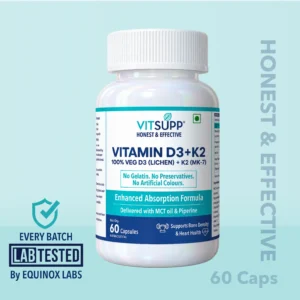
That is why supplement formulation is crucial. VitSupp focuses on supplement formulation and using highly bioavailable ingredients in its offering, including the Vitashine Vegan D3 + BioEssence K2 MK-7. The 100% vegetarian HPMC capsules contain MCT oil, which helps vitamin D3 absorb quickly and supports calcium absorption.
Why Does VitSupp Use HPMC Capsules?
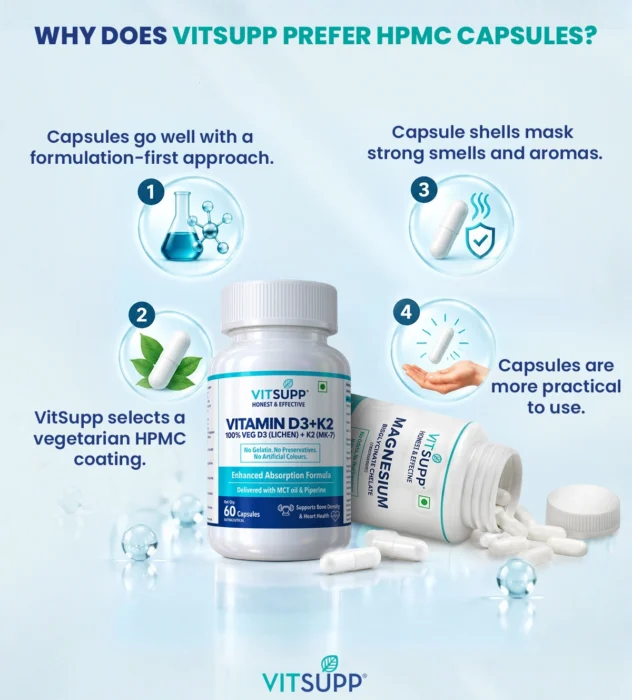
VitSupp’s choice of capsules for its supplements is not only because of capsule advantages. The main idea is that the dosage form should be ideal for the formulation, and each ingredient should have a clear purpose.
Capsules Fit a Formulation-First Approach
Supplement brands manufacture tablets as compressed solid units. Their formulations generally contain different functional excipients including disintegrants, lubricants, film coatings, fillers, and binders. However, these ingredients have specific roles to play. A binder may help a tablet maintain its structure, and a lubricant can support consistent manufacturing.
A capsule has a distinct manufacturing method. The formulation is put into a preformed shell, and compression is not necessary. One of the advantages of capsules is that they do not need additional ingredients just to retain the structure and shape.
VitSupp Uses Vegetarian HPMC Shells
A number of OTC supplement brands use gelatin to make capsule coatings. The downside is that they obtain gelatin from animal-origin collagen. So, vegans and vegetarians cannot use such supplements.
VitSupp is keen on offering pure vegan supplements and so chooses HPMC, or hydroxypropyl methylcellulose, for capsule coatings. This is a plant cellulose-based material, making its capsules ideal for vegan users.
Capsule Shells Help Tackle Strong Taste and Aroma
Some active ingredients in supplement formulations may have a strong taste or aroma, which users may not like. With a capsule shell made of HPMC, these attributes do not overpower users’ senses. Pharmaceutical literature mentions capsules as useful for masking strong taste or odor. When comparing capsules vs tablets, this comes across as a practical benefit.
Capsules Are Practical for Daily Use
While swallowability is individual, a section of users finds the soft form of capsules easier to swallow than tablets. The size, shape, and texture play key roles here.
For VitSupp, the motto is not to go for capsule form at all times. It chooses capsules as a dosage form that works with its current formulations. The use of vegetarian HPMC capsule shells supports its core principle of using minimal ingredients where possible, while discarding unnecessary items.
Does it Mean Tablets Are Inferior?
The simple answer is no. The advantages of capsules are obvious, but tablets remain among the popular oral dosage forms for supplementation and medication. They are stable, easy to handle, and easy to manufacture, in general.
Brands manufacture tablets for different release patterns. Traditional tablet-manufacturing methods are often cost-effective and scalable. However, the manufacturing cost ultimately depends on the formulation and processes, and not only on the dosage form, according to PubMed.
Eventually, supplement stability and shelf life depend not only on the form. It depends on factors like the active ingredient, excipients, manufacturing method, packaging, and storage conditions. VitSupp’s choice of capsule form is driven by the theory of choosing the dosage form that matches the formulation better.
Capsule vs Tablet- An In-depth Comparison
The capsule vs tablet choice is not only about the physical form and appearance. They differ in structure, manufacturing requirements, possible release designs, and dietary considerations.
| Factor | Capsules | Tablets |
|---|---|---|
| Basic Composition | Ingredients are put within a capsule shell, and its contents may include powders, pellets, or liquids. | Ingredients are formed into a solid unit, commonly using compression during manufacturing. |
| Formulation aids | Capsules avoid the tablet-compression step, although their contents may still need functional excipients. | Tablet formulations may contain fillers, binders, disintegrants, lubricants, or other excipients for specific manufacturing and performance functions. |
| Ingredient capacity | The amount to be filled is limited by capsule dimensions and the physical properties of the formulation. | Tablets come in different sizes and strengths, although increasing tablet size can reduce swallowability. |
| Shell or coating | Capsules can use different shell systems, made from vegetarian or animal sources. | Tablets come in coated or uncoated forms depending on the formulation and release needs. |
| Swallowing experience | Some people may prefer capsules, but size and other physical characteristics affect acceptability. | Tablet size and shape also influence swallowability; larger size can make swallowing tougher for some users. |
| Release options | Capsules come in conventional, delayed-release, or extended-release dosage forms. | Tablets can also offer immediate, delayed, or extended release. |
| Stability | Depends on the ingredient, capsule material, formulation, packaging, and storage conditions. | Also depends on formulation and storage; A tablet alone does not always ensure a long shelf life. |
The notable thing is that neither form emerges as an absolute winner for absorption. A capsule may release its contents differently from a tablet. However, oral performance also depends on the complete formulation, including dissolution and other biopharmaceutical traits.
Conclusion
After analyzing the differences between tablet and capsule forms, it is obvious that both forms have their benefits. Both are effective dosage forms and get the nod from the FDA.
VitSupp chooses capsules since this form helps implement its formulation-first approach better. For its supplement lineup, capsules fit the need to deliver the formulation. It chooses vegetarian HPMC shells to make the products truly free of animal extracts. So, there is no lanolin or gelatin.
As for the other ingredients in its capsules, they are there to support the formulation’s efficacy. In the Vitamin D3 and K2 supplement, 95% piperine extract and MCT oil are used to support the absorption of vitamin D.
The choice of HPMC capsules reflects its broader formulation philosophy. It helps keep the formula purposeful, retain only the required ingredients, and offer a product that covers the needs of target users. Also, all the capsules undergo third-party testing, and manufacturing takes place in an FSSAI- and GMP-approved facility.
VitSupp uses capsules for convenient, easy supplementation. Learn more about Vitamin D absorption, carrier oils, and proper dosage in our detailed guide.
Read the guide https://www.vitsupp.com/blog/vitamin-d-absorption-role-of-carrier-oils-proper-dosage/
FAQs
1. What is the difference between capsules and tablets?
Capsules and tablets are both common solid oral dosage forms. However, their manufacturing process is quite different. Tablet manufacturing involves compressing active ingredients with specific excipients into a solid unit. Capsules contain the formulation inside a hard or soft shell. Inside capsules, you may find either liquid or powder ingredients. Both forms are developed for immediate or delayed release. The structural difference between capsules and tablets, however, does not mean one form always absorbs better. Ultimately, the absorption will vary based on factors like dissolution, solubility, and intestinal permeability.
2. What are the benefits of capsules over tablets?
The advantages of capsules over tablets are quite obvious.
- Capsules may contain several ingredients, and the compression method is not necessary. So, brands can avoid using additional fillers when making capsules. This is a reason why brands like VitSupp prefer capsule form over tablets.
- Capsule shells can also help mask the strong aroma and taste of the ingredients in them.
- Softshell capsules are easier to swallow compared to hard tablets.
3. Do capsules work faster than tablets?
It is not always so. While a capsule may release its contents differently from a tablet, the dosage form is not the sole determiner of how fast it works. According to the FDA, absorption from an oral solid dosage form depends on aspects like intestinal permeability, dissolution, and release from the product.
Another important factor is release design for both forms. Tablets and capsules can both be developed for immediate or delayed release of the formulation. So, a quickly dissolving capsule shell may not always ensure faster absorption. You have to check the complete formulation, not only the form factor.
4. Which is easier to swallow: capsules or tablets?
There is a general perception that capsules are easier to swallow compared to tablets. However, swallowability eventually depends on aspects like the product’s size, shape, surface, and dimensions. Larger tablets or capsules may be harder to swallow. However, softshell capsules generally pose fewer hardships in this context. Comparative studies do not consistently point to capsules as the easier form to swallow. So, from a logical perspective, the concept that capsules are easier to swallow is more of an individual preference, not a thumb rule.
5. When should you choose capsules over tablets?
Ideally, you should choose capsule form when the specific formulation, shell material, and swallowing experience suit your needs. Different oral dosage formulations suit different purposes. Capsules are especially better when brands do not want to use unnecessary or extra ingredients in the supplement formulation. It also works when they want users to face less hardship in swallowing. The size plays a role here, as large tablets and capsules are harder to swallow.
6. Do capsules improve nutrient absorption compared to tablets?
This should not be taken as a generalized rule. A capsule shell may release its contents differently from a tablet. However, the dosage form alone does not affect nutrient absorption. Oral absorption depends on many other factors like solubility, dissolution, and intestinal permeability. Human studies reveal that the relative bioavailability of nutrients can differ based on the nutrient and formulation, over a specific dosage form.
7. Are capsules better for the stomach than tablets?
There is no such thumb rule despite the obvious advantages of capsules. Stomach tolerance depends largely on the active ingredient, dose, excipients, etc. Both capsules and tablets can be designed to release ingredients slowly or quickly. Delayed release products may use enteric coatings so that their ingredients release only after coming in contact with stomach acids. So, we should not automatically assume that capsules are always gentler on the stomach. The tolerability of a supplement should be assessed from the complete formulation, not the form factor.
8. Are capsules better for sensitive ingredients than tablets?
That is applicable for some formulations, but not as a general rule. Capsules are suitable for using certain powders, pellets, non-aqueous liquids, and semi-solid formulations. The form offers formulators flexibility when an ingredient does not suit tablet compression. One peer-reviewed study mentions this factor as one of the capsule advantages.
A lot depends on the shell or coating, packaging, and storage conditions. The protection from environmental elements like moisture and heat matters.
9. Do capsules and tablets have the same effectiveness?
Youcan’tt determine the effectiveness from the dosage form alone. Tablets and capsules can both come with active ingredients that serve the intended purpose. The efficacy is there when the formulation stays stable, and there are ingredients that help improve the bioavailability. For example, in VitSupp’s vitamin D3 and K2 supplement, the presence of MCT oil as a carrier helps support absorption of the nutrients.
10. How do you choose between capsule and tablet supplements?
When comparing capsule vs tablet supplements, do not focus solely on the form factor. Check the active ingredient, its amount per serving, serving size, and other ingredients in the formulation. Also, look for the capsule shell or coating ingredients used. Vegan users, for example, should not choose capsule products that use gelatin coating. Swallowability is another factor, and here capsules generally score over tablets. Also, look for third-party lab testing and compliance with standards like GMP- both of which you get with VitSupp.