
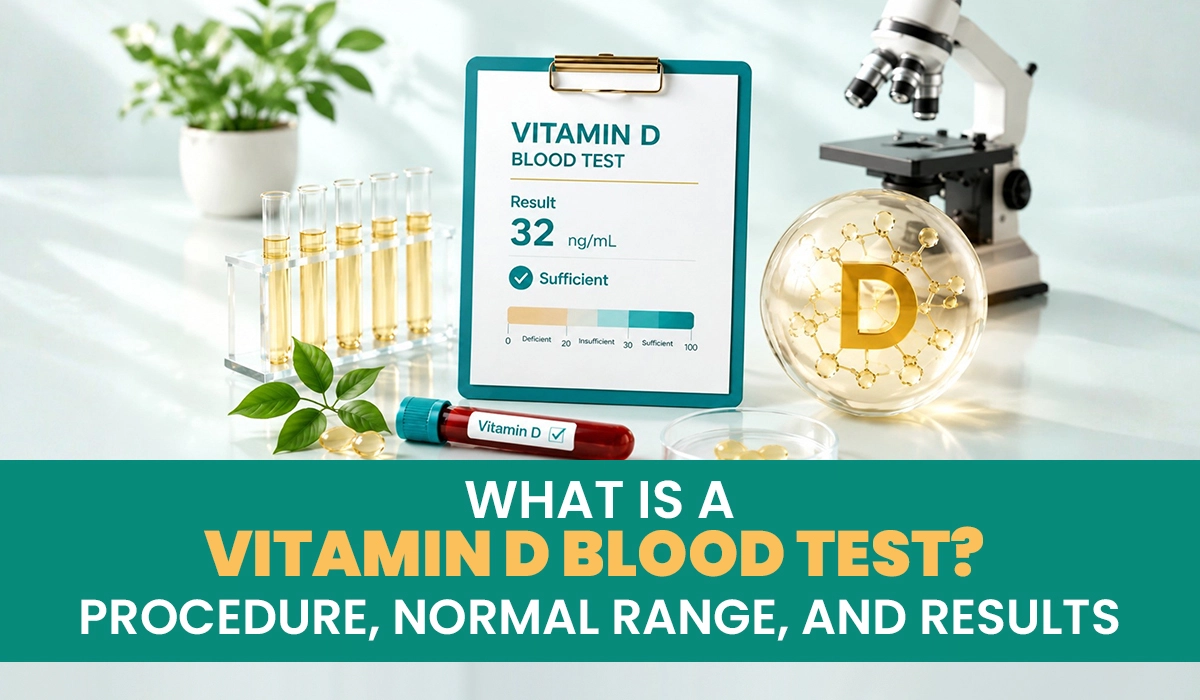
Chronic fatigue, muscle weakness, or general health concerns can indicate you are deficient in vitamin D, but symptoms alone cannot confirm that. If you want to know for sure, you should go for a vitamin D blood test. It gives you measurable, objective information about your vitamin D status instead of leaving you to interpret vague symptoms on your own.
Understanding the terms, the procedure, the normal range, and how to read your test results correctly may help you make informed decisions about your health, lifestyle, and whether supplementation makes sense for you. This guide breaks down each of these pieces in simple language.
What Is a Vitamin D Blood Test and What Does It Measure?
A vitamin D blood test is done to measure the amount of vitamin D present in your blood. It’s a simple test, but it plays an important role in your overall nutritional and bone health picture.
Most commonly, the test measures a compound called 25-hydroxyvitamin D, or 25(OH)D. This is the standard marker doctors rely on because it reflects vitamin D from both sun exposure and diet or supplements, giving a fairly complete picture of your status.
You might wonder why doctors don’t test the “active” form of vitamin D instead. The reason is stability:
- The active form is used up quickly and doesn’t stay in the blood long enough for a reliable reading.
- 25-hydroxyvitamin D circulates for weeks, making it a dependable marker of how much vitamin D you have stored.
- This is the key difference between circulating vitamin D (what the test measures) and active vitamin D (what your cells actually use).
Common Names of Vitamin D Blood Tests
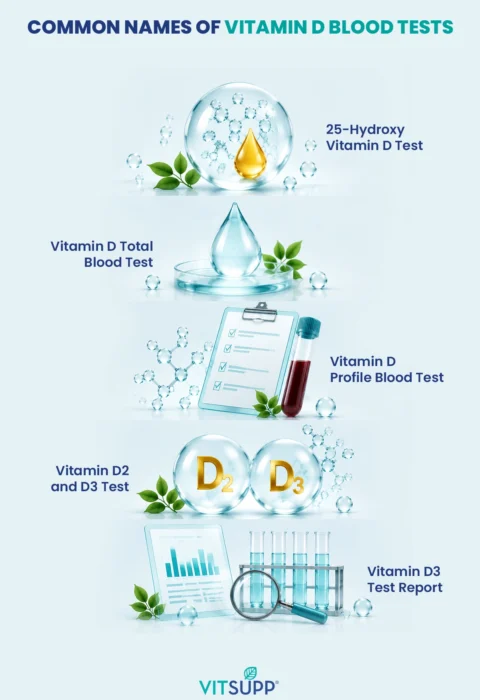
The same basic test may appear under different names depending on the lab:
- 25-Hydroxy Vitamin D Test
- Vitamin D Total Blood Test
- Vitamin D Profile Blood Test
- Vitamin D2 and D3 Test
- Vitamin D3 Test Report
Vitamin D3 (cholecalciferol) and vitamin D2 (ergocalciferol) are the two major forms of vitamin D. Your skin usually produces vitamin D3 from sunlight. On the other hand, vitamin D2 usually comes from either plant-based sources or fortified foods.
Most standard pathological tests report a combined total, whereas only some advanced panels break the two down separately.
Why Is a Vitamin D Test Recommended?
Vitamin D testing isn’t something everyone needs on a routine basis, but doctors typically recommend it when there’s:
- A suspected vitamin D deficiency, often flagged due to fatigue or low energy
- A need to monitor how well ongoing supplementation is working
- Bone health concerns
- Muscle weakness
- Limited sun exposure
- A condition that may affect nutrient absorption
Factors that may increase the need for testing:
| Factor | Why It Matters |
| Limited sunlight exposure | Less UVB means less natural vitamin D production |
| Older age | Skin becomes less efficient at producing vitamin D |
| Digestive conditions (e.g., celiac disease) | Can interfere with nutrient absorption |
| Kidney or liver conditions | These organs help convert vitamin D into its usable form |
| Certain medicines | May affect how the body metabolizes vitamin D |
How Is Vitamin D Tested in Blood?
Vitamin D Blood Test Procedure
- A technician draws a small blood sample, usually from a vein in your arm.
- A thin needle is inserted, a small vial of blood is collected, and the site is bandaged.
- The sample is sent to a laboratory to measure your 25-hydroxyvitamin D levels.
- Labs use standardized methods to keep readings accurate and comparable.
Do You Need to Fast for a Vitamin D Blood Test?
Usually, no. You may eat and drink normally before the test if this is the only test you are aiming for, since food intake doesn’t meaningfully change your 25-hydroxyvitamin D level in the short term. If it’s combined with other blood work, such as a lipid or sugar test, you may be asked to fast for a set number of hours, so it’s best to follow your lab’s specific instructions rather than assuming either way.
Are Special Preparations Needed?
- Let your doctor know if you’re already taking vitamin D supplements.
- Share relevant medical history, such as digestive, kidney, or liver conditions, or any medications you’re on.
How to Read a Vitamin D Test Report?
Understanding Vitamin D Test Results
Your report typically shows:
- A test value
- A measurement unit (ng/mL or nmol/L, depending on the lab)
- A laboratory reference range used to classify your result as low, adequate, or high
These ranges are guidelines, not strict cutoffs. Two people with similar numbers might be advised differently based on age, health history, and overall condition.
Vitamin D Normal Range
| 25(OH)D Level | General Interpretation |
| Below 12 ng/mL | Deficiency range |
| 12–20 ng/mL | Often considered inadequate |
| 20 ng/mL and above | Generally adequate for many individuals |
| Very high levels | May require medical evaluation |
The normal vitamin D range in blood tests can vary by laboratory and testing method, which is why your doctor’s interpretation matters more than reading the number in isolation. Age, existing conditions, and medical history all factor into how a result should be read.
Is Vitamin D Normal Range Different for Females?
There is generally no separate vitamin D range specifically for women; the reference values are largely the same across genders. That said, doctors may interpret a woman’s results differently depending on:
- Pregnancy
- Women during midlife
- Osteoporosis risk
So while the numerical range doesn’t usually change, the clinical judgment applied to it can.
What Happens If Vitamin D Is Low?
Vitamin D helps your body absorb calcium and maintain normal bone health. When levels drop too low, this process becomes less efficient. Low levels may affect:
- Bone strength – calcium isn’t absorbed and used as effectively
- Muscle function – a common reason behind reported weakness
- Physical performance – including fatigue or reduced stamina
Over time, persistently low levels can lead to more serious outcomes, such as osteomalacia in adults (softening of the bones) or rickets in children (affecting bone development).
Why Does Vitamin D Deficiency Occur?
| Cause | What’s Happening |
| 1. Limited sun exposure | Indoor lifestyles and long work hours reduce UVB exposure, lowering natural vitamin D production |
| 2. Dietary limitations | Very few foods naturally contain meaningful vitamin D; fortified foods help but rarely close the gap alone |
| 3. Absorption problems | Vitamin D is fat-soluble, so conditions like celiac disease can affect its absorption even with adequate intake |
| 4. Age and body changes | Skin becomes less efficient at producing vitamin D as we age |
| 5. Medical conditions and medicines | Liver and kidney conditions can disrupt vitamin D metabolism, as can certain medications |
How to Counter Vitamin D Deficiency?

Improving your vitamin D levels usually isn’t about one single thing. It’s a combination of safe sun exposure, specific dietary choices, along with supplementation whenever needed. It should be guided by what your test results actually show.
Improve Sun Exposure Safely
Several factors affect how much vitamin D your skin can produce:
- Geographic location
- Season
- Skin tone
- Clothing coverage
- Local pollution levels, which can reduce UVB reaching your skin
Include Vitamin D Sources in Your Diet
- Fatty fish
- Egg yolks
- Fortified foods (certain dairy products or cereals)
- UV-exposed mushrooms
- Vegetarian vitamin D3 sources, such as lichen-derived D3, for those avoiding animal-derived forms
Consider Vitamin D Supplements When Needed
For those with confirmed low levels or limited sun and dietary intake, a doctor may recommend vitamin D supplements. The dosage should vary depending on individual needs and guidance, not guesswork, since too much can be just as unhelpful as too little. Retesting after a few months checks whether levels have actually improved.
Choosing the Right Vitamin D Supplement After Testing
If supplementation is on the table, a few things are worth evaluating before you choose one:
| What to Check | Why It Matters | Why VitSupp Vitamin D3+K2 |
| Form (D3 vs D2) | Vitamin D3 (cholecalciferol) is generally a lot more effective than vitamin D2 (ergocalciferol) | Uses vitamin D3 (600 IU), the more effective and biologically active form, rather than D2 |
| Source | Determines whether it’s vegetarian-friendly or animal-derived | Lichen-derived, making it fully vegetarian with no lanolin or animal involvement |
| Dosage | Should match your actual test results and needs | A measured 600 IU of D3 with 45 mcg of K2 MK-7, kept within sensible, evidence-aligned levels rather than a megadose |
| Delivery format | Fat-soluble vitamins absorb better with a fat-based carrier | Delivered in an MCT oil base, a fat carrier that supports absorption of this fat-soluble vitamin |
| Supporting ingredients | Can influence how well the nutrient is used by the body | Includes Piperine (black pepper extract) to further aid bioavailability, alongside K2 MK-7 for proper calcium direction |
| Manufacturing quality and transparency | Reflects how reliable and consistent the product is | Manufactured in a GMP-certified facility, batch-tested for purity and potency, with no proprietary blends on the label |
Lichen vs Lanolin: Why Source Matters
Most vitamin D3 supplements are made from lanolin, a substance derived from sheep’s wool. This works well biologically, but it isn’t suitable for anyone following a vegetarian or vegan lifestyle. Lichen-derived vitamin D3 is basically a plant-based alternative that can deliver the same active form of vitamin D3 but without any animal involvement. Therefore, it is a meaningful distinction if you’re checking labels closely, since not every “D3” supplement is automatically vegetarian just because it uses the D3 form.
Why Fat Presence Matters When You Take Vitamin D
Vitamin D is a fat-soluble vitamin, which means your body needs some dietary fat present to absorb and use it properly. Taking a vitamin D capsule on a completely empty stomach, with no fat in sight, can significantly reduce how much of it your body actually absorbs. This is why some formulations are built with a fat-based carrier, such as MCT oil, right inside the capsule. It’s also a good reason to take your supplement alongside a meal that includes some healthy fat, rather than with water alone first thing in the morning.
Why VitSupp Vitamin D3+K2 Supplement
VitSupp’s Vitamin D3 + K2 reflects this kind of thoughtful formulation. It uses lichen-derived vitamin D3, a vegetarian source, paired with vitamin K2 MK-7 to support how calcium is used in the body. Delivered in an MCT oil base for better absorption, with Piperine added to further support bioavailability, and packaged in a vegetarian capsule, it’s built on clear reasoning, not vague claims.
Conclusion
A vitamin D blood test is an absolutely useful process for understanding your vitamin D status rather than relying on guesswork. Most of the commonly used tests measure 25-hydroxyvitamin D. Hence, they provide a fairly reliable snapshot of how much vitamin D is circulating in your body.
Understanding your report properly means looking beyond a single number. Your lifestyle, diet, medical history, and your doctor’s judgment all play a role in what your results mean for you. Testing simply gives you the information to make informed decisions about sunlight, food, and supplementation.
Therefore, if you are exploring proper Vitamin D3 supplements, it’s worth looking into VitSupp’s scientifically designed Vitamin D3 + K2 formulation. It is created with carefully selected ingredients and a transparent approach to everyday wellness.
Frequently Asked Questions
1. What is a vitamin D blood test?
A vitamin D blood test is a way to measure the amount of vitamin D that is circulating in your blood. It is usually done by checking 25-hydroxyvitamin D levels. It gives a reliable snapshot of your vitamin D status from both sun exposure and diet, helping you and your doctor understand whether your levels are low, adequate, or high.
2. Why do I need a vitamin D test?
You may need to go through this test if you have symptoms like fatigue, muscle weakness, limited sun exposure, or any particular condition affecting vitamin absorption. It’s also used to monitor supplementation progress. Rather than guessing based on how you feel, the test gives measurable clarity, helping you decide if products like VitSupp’s Vitamin D3 + K2 are worth considering.
3. What happens during a vitamin D blood test?
A phlebotomist, nurse, or trained laboratory technician draws a small blood sample from a vein in your arm using a thin needle. The sample is sent to a laboratory, where 25-hydroxyvitamin D levels are measured. The process takes only a few minutes, requires no special equipment on your part, and usually doesn’t need fasting beforehand.
4. What do vitamin D test results mean?
Your vitamin D test report shows a numeric value along with the laboratory reference range. This range classifies your level as low, adequate, or high. These ranges are basically guidelines rather than strict rules. Your doctor will consider your age, health history, and lifestyle alongside the number itself before deciding what it means for you.
5. How much vitamin D is normal?
Usually, levels below 12 ng/mL indicate vitamin D deficiency, 12 to 20 ng/mL is generally considered inadequate, whereas 20 ng/mL and above is generally adequate for most of the people. Exact range may vary slightly so it’s best to interpret your specific report alongside your doctor’s guidance.
6. What happens if vitamin D is low?
If you have low vitamin D, it may affect your calcium absorption, bone strength, as well as muscle function. Also, over time, it may contribute to osteomalacia in adults or rickets in children. That said, fatigue or mood changes may stem from multiple causes, so a low result should be considered alongside your overall health picture, not in isolation.
7. What can cause low vitamin D levels?
Common causes of low vitamin D levels include various reasons like- limited sun exposure, poor dietary intake, and absorption issues linked to conditions like celiac disease. Aging skin, certain medications, and liver or kidney conditions can also play a role. Understanding your specific cause helps determine whether lifestyle changes or a formulation like VitSupp’s Vitamin D3 + K2 makes sense.
8. Can vitamin D deficiency cause sleep problems?
Some of the scientific research suggests a possible link between low vitamin D and disrupted sleep patterns, though the relationship isn’t fully understood and sleep issues often have multiple contributing factors. If you’re experiencing ongoing sleep trouble alongside other symptoms, it’s worth discussing testing and other potential causes with your doctor.
9. How does pollution affect vitamin D production?
In today’s world, pollution is a great concern. Air pollution can block UVB rays from reaching your skin, reducing your body’s natural ability to produce vitamin D even with regular outdoor time. This is specifically relevant in densely populated urban areas, where haze and particulate matter are more common, making dietary sources and supplementation more relevant.
10. Can I get enough vitamin D through diet alone?
For most people, diet alone can only provide limited vitamin D, since very few foods naturally contain meaningful amounts. Fortified foods help, but often don’t close a significant gap by themselves. This is why many people also rely on sensible sun exposure and, when needed, a well-formulated supplement such as VitSupp’s Vitamin D3 + K2.