You get your blood work done. The report comes back, and there it is: low vitamin D. Your doctor recommends a supplement, you pick one up, and you start taking it every morning. Weeks pass. Some people feel a difference. Others don’t. And almost no one stops to ask the more useful question: what actually happens to vitamin D once it enters the body?
You go looking for a supplement and find the shelf split in two- plain D3 on one side, D3+K2 on the other, and no clear answer on which one you actually need. Vitamin D deficiency is now counted as one of the most common nutritional gaps among urban Indian adults, across all age groups, diets, and lifestyles. But here’s what most people never learn: swallowing a vitamin D capsule doesn’t mean your body can use it right away. Vitamin D undergoes metabolic conversion in the body before exerting its biological effects.
Vitamin D has to go through a multi-step conversion process, involving the liver and the kidneys, before it becomes biologically active. And once it’s active, Vitamin K participates in a separate part of calcium physiology through vitamin-K-dependent proteins.
Here we will learn how the human body actually works with Vitamin D, from intake to activation to calcium absorption to calcium regulation, and what that means for your bones and overall health. This is exactly the sequence VitSupp believes every supplement choice should be built on, separating guesswork from real clarity.
Do You Need Vitamin K with Vitamin D?
The short answer: not for absorption, but direction. Vitamin K is not required for Vitamin D absorption or activation, but the two nutrients have complementary roles in calcium physiology. Vitamin D activates fully on its own, through the liver and kidneys, without any help from vitamin K.
But Once active Vitamin D supports intestinal calcium absorption, Vitamin K has a separate role in activating vitamin-K-dependent proteins involved in calcium metabolism. The two nutrients aren’t competing or interchangeable; They have distinct but complementary roles in calcium and bone physiology. Vitamin D is a fat-soluble vitamin whose active metabolite, calcitriol, functions as a hormone in the body.
Understanding Vitamin D: Why Your Body Needs This Nutrient
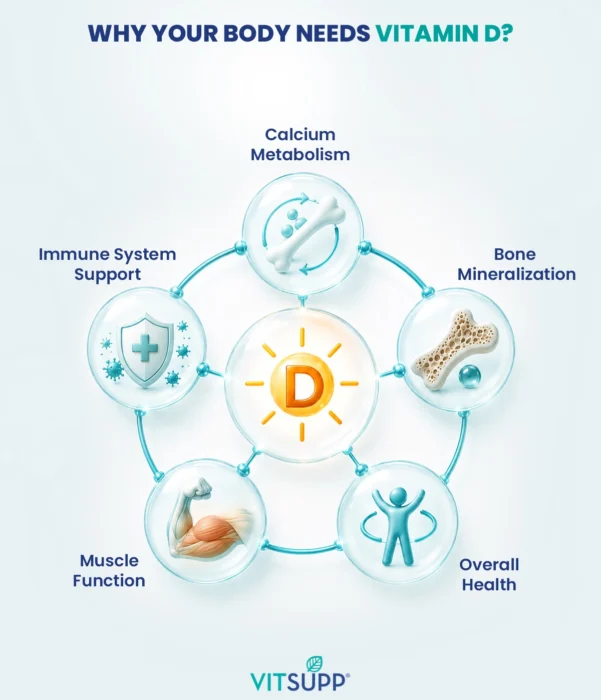
Vitamin D is a fat-soluble vitamin. It behaves less like a typical vitamin and a lot more like a hormone. Once activated, it circulates through the body and influences several core functions:
- Calcium metabolism– It is a way of helping the body manage how much calcium is absorbed and used
- Bone mineralization– It is a way of supporting the process by which bones stay strong and dense
- Muscle function– Muscle function – Vitamin D contributes to normal muscle function.
- Immune system support– It is about playing a role in normal immune response
- Overall health– It means influencing several systems that depend on adequate calcium and mineral balance
Why Vitamin D Deficiency Is Becoming More Common These Days
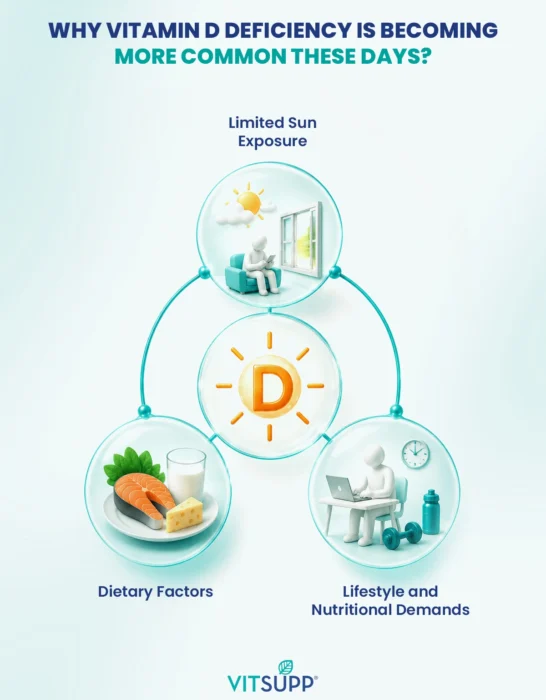
Vitamin D deficiency isn’t rare or unusual. Vitamin D deficiency and insufficiency have been widely reported in India, including among urban populations. A few reasons stand out:
1. Limited Sun Exposure: Most working professionals today spend the bulk of daylight hours indoors, commuting in closed cars, sitting through long office hours under artificial light, or working remotely from home. The body has its primary natural source of vitamin D- sunlight on bare skin- but simply doesn’t get enough of a chance to do its job.
2. Dietary Factors: There are very few foods that naturally contain meaningful amounts of vitamin D. Most people end up relying on a handful of fortified foods, which are inconsistent in both availability and the amount of vitamin D they actually deliver.
3. Lifestyle and Nutritional Demands: As people age, the skin becomes less efficient at producing vitamin D from sunlight. Add to this changing dietary patterns, age, limited sun exposure, skin pigmentation, clothing, dietary intake and other individual factors can influence Vitamin D status., and it’s easy to see why so many routine blood tests are turning up low vitamin D levels.
How Your Body Activates Vitamin D: The Vitamin D Activation Process
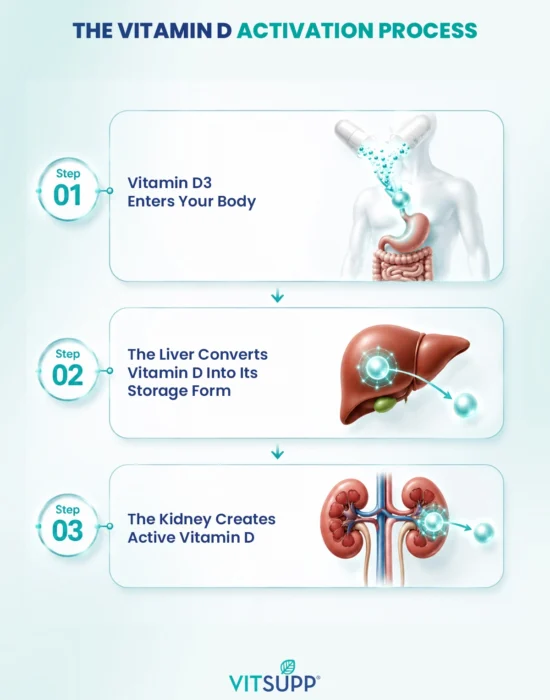
This is the part almost no one is taught, and it’s the key to understanding why formulation, not just intake, matters.
Step 1: Vitamin D3 Enters Your Body
Vitamin D3 can enter the body through three main routes: sunlight exposure, a small number of food sources, and dietary supplements. Vitamin D3 (cholecalciferol) is the same form your skin naturally produces after sun exposure, but at this stage, it is still biologically inactive.
Think of it this way: vitamin D enters your body like an unfinished key. It has the right shape, the right material, but it needs a few more biological steps cut into it before it can actually unlock anything.
Step 2: The Liver Converts Vitamin D Into Its Storage Form
From here, vitamin D travels to the liver, where it’s converted into 25-hydroxyvitamin D, also written as 25(OH)D. This is the storage form of vitamin D, and it’s also the form measured when you get a vitamin D blood test. The liver converts Vitamin D to 25-hydroxyvitamin D [25(OH)D], the major circulating form and the marker commonly measured to assess Vitamin D status. When your report shows a number and a “deficient/ insufficient/ sufficient” range, it’s this specific compound being measured, not the active form.
Step 3: The Kidney Creates Active Vitamin D
The 25-hydroxyvitamin D then travels to the kidneys, where it undergoes a second conversion into its fully active form: 1,25-dihydroxyvitamin D, sometimes called calcitriol. This is the form that actually does the work, regulating calcium and phosphorus balance and supporting normal bone mineralization throughout the body.
Vitamin D and Calcium Absorption: Understanding the Connection
In the human body, vitamin D and Calcium absorption are connected. Let’s understand this in detail-
How Vitamin D Supports Calcium Absorption
Once active, vitamin D’s best-known role kicks in: helping the intestine absorb calcium from the food you eat. Calcium is a mineral your body depends on for bone structure, nerve signaling, muscle contraction, and several other normal functions, but adequate Vitamin D supports efficient intestinal calcium absorption.
Calcium Absorption Is Only One Part of Calcium Balance
Here’s where the common misconception remains. Many people assume that more absorbed calcium automatically helps with stronger bones. While in reality, healthy calcium metabolism depends on several linked processes, not just one:
- Absorption: getting calcium out of food and into the bloodstream
- Transport: moving calcium through the body to where it’s needed
- Utilization: putting calcium to use in bone and tissue
- Regulation: making sure calcium ends up in the right places, in the right amounts
Vitamin D plays an important role in supporting intestinal calcium absorption.. But when it comes to Calcium metabolism involves more than absorption alone. Vitamin K contributes through the activation of vitamin-K-dependent proteins involved in normal bone and calcium physiology. This is exactly where vitamin K becomes relevant.
Vitamin K1 vs Vitamin K2: Understanding the Difference
Vitamin K usually exists in the form of Vitamin K1 and Vitamin K2.
| Feature | Vitamin K1 (Phylloquinone) | Vitamin K2 (Menaquinone) |
| Primary Sources | Mainly found in plant-based foods, especially green leafy vegetables | Found in fermented foods and some animal-based foods |
| Common Food Sources | Spinach, kale, broccoli, and other leafy greens | Fermented foods and certain animal-derived foods |
| Main Role in the Body | Primarily supports normal blood clotting functions | Supports the activation of vitamin K-dependent proteins involved in calcium regulation |
| Forms | Mainly exists as phylloquinone | Exists in different forms, including MK-4 and MK-7 |
| Use in Supplements | Less commonly used in vitamin D combination supplements | Commonly used in Vitamin D3 + K2 formulations, especially MK-7 |
| Why MK-7 Is Used | — | MK-7 is often used in supplements because it has a longer presence in the bloodstream compared with some other forms of vitamin K2 |
Choosing a Vitamin D3 + K2 Supplement: Why Formulation Matters
Once you understand the activation-to-regulation sequence, the logic behind a thoughtfully built D3+K2 formulation starts to make a lot more sense.
Why Vitamin D3 Is Preferred in Supplements
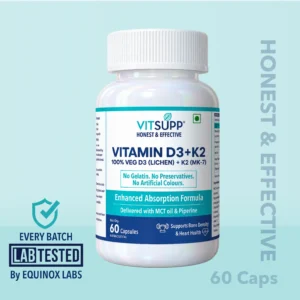
Vitamin D3 (cholecalciferol) is preferred because it’s the same form your skin produces after sun exposure. VitSupp’s Vitamin D3+K2 uses a 100% vegan Vitamin D3, sourced from lichen, so vegetarians and vegans aren’t limited to lanolin-derived sources, which is where most conventional D3 comes from.
Why Vitamin K2 (MK-7) Is Included
Since K2 activates the calcium-regulating proteins discussed earlier, it’s the more relevant form to pair with vitamin D. VitSupp uses Vitamin K2 in the MK-7 (menaquinone-7) form, recognized for staying active in the bloodstream longer, supporting more consistent daily dosing.
Supporting Absorption Through Thoughtful Design
As vitamin D is fat-soluble, how it’s delivered matters almost as much as the dose. A dry tablet doesn’t absorb like a fat-carried capsule. VitSupp’s D3+K2 is built around an MCT oil base with piperine (black pepper extract), designed for how a fat-soluble nutrient needs to travel through the body.
Check the detailed blog on The Science of Better Absorption: How Carrier Oils & Dosage Impact Your Vitamin D Levels
Vitamin D3 + K2 Benefits: Supporting Everyday Wellness
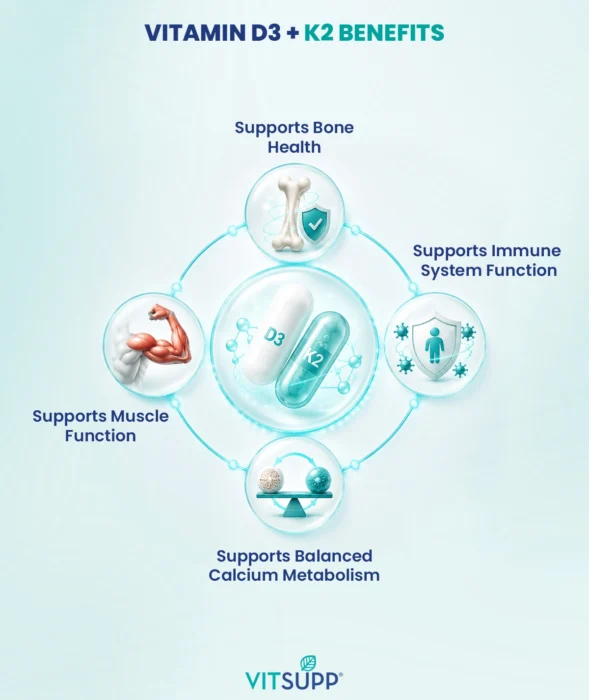
Understanding vitamin D activation and vitamin K2’s role in the process of calcium regulation shows these benefits are ongoing outcomes, not overnight fixes.
1. Supports Bone Health
Through its combined role in calcium metabolism and bone mineralization, an adequately maintained vitamin D level, with K2 support, contributes to normal bone health over time.
2. Supports Muscle Function
Vitamin D plays a recognized role in normal muscle function, which is one reason low levels are often associated with generalized fatigue or muscle aches.
3. Supports Immune System Function
Adequate vitamin D levels are associated with normal immune system function, making it a nutrient worth monitoring year-round, not just during winter months.
4. Supports Balanced Calcium Metabolism
Taken together, vitamin D and vitamin K2 support a more complete picture of calcium metabolism: one nutrient increasing calcium availability, the other supporting how that calcium is regulated in the body.
How to Maintain Healthy Vitamin D and Vitamin K Levels
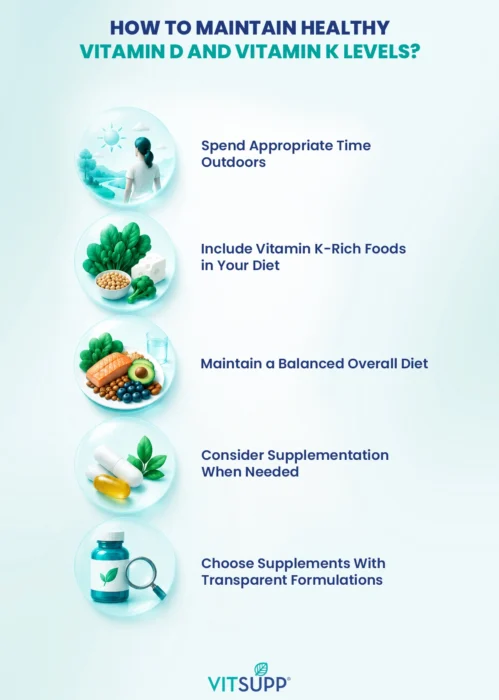
Supplementation is one part of a bigger picture. A few practical habits go a long way:
- Spend appropriate time outdoors. Even 15 to 20 minutes of midday sun exposure on exposed skin, a few times a week, can meaningfully support natural vitamin D production.
- Include vitamin K-rich foods in your diet. This is an important part of maintaining proper vitamin levels. Leafy greens like spinach, methi, and other seasonal vegetables contribute vitamin K1.
- Maintain a balanced overall diet. Nutrient interactions matter more than any single “hero” nutrient.
- Consider supplementation when dietary and sun exposure sources fall short. This is particularly relevant for those people who spend limited time outdoors or have specific dietary restrictions.
- Choose supplements with transparent formulations. Before using, we must check for named ingredient forms, clear dosing, and third-party testing rather than vague marketing claims.
Conclusion
The honest answer: vitamin D works on its own, but pairing it with K2 supports a more complete picture of calcium regulation, which is why VitSupp includes both rather than making you choose.
Vitamin D needs a genuine, multi-step activation process through the liver and kidneys before it can support calcium absorption and bone mineralization. Once that calcium is in circulation, vitamin K2 steps in, helping activate the proteins responsible for calcium regulation throughout the body.
Neither nutrient replaces the other, and neither does the whole job alone. A well-designed supplement considers nutrient forms, delivery, and formulation quality together.
VitSupp offers a scientifically designed Vitamin D3 + K2 formulation, built with clean ingredients and transparent labeling to support your everyday wellness journey.
Important: Vitamin K can interact with vitamin-K-antagonist anticoagulants such as warfarin. People taking these medicines should consult their healthcare professional before starting or changing Vitamin K supplementation.
FAQs
1. How is vitamin D activated in the body?
Vitamin D enters the body through sunlight, food, or supplements as vitamin D3. It travels to the liver, converting into 25-hydroxyvitamin D, the form measured in blood tests, then to the kidneys, becoming active and supporting calcium regulation and bone mineralization.
2. How do vitamin D and vitamin K work together in the body?
Vitamin D improves how much calcium your body can absorb and has available, and Vitamin K2 activates vitamin K-dependent proteins involved in calcium regulation. VitSupp‘s D3+K2 formulation is built around this complementary, sequential relationship rather than treating either nutrient in isolation.
3. What happens if vitamin D is taken without vitamin K?
Vitamin D still performs its core biological functions independently and does not require vitamin K to be absorbed or activated. However, nutrition science increasingly recognizes that considering how nutrients interact, rather than supplementing in isolation, supports a more complete approach to calcium metabolism overall.
4. Which form of vitamin K is best to take with vitamin D?
MK-7 is a commonly used supplemental form of Vitamin K2. Its relatively long circulating half-life makes it suitable for once-daily supplementation. Vitamin K2 is generally considered more relevant than K1 when pairing with vitamin D, since K2 is more directly involved in activating calcium-regulating proteins. Within K2, the MK-7 form is commonly preferred because it stays active in the bloodstream longer, supporting consistent once-daily use.
5. Can vitamin D increase calcium absorption without proper vitamin K support?
Yes. Calcium absorption and calcium regulation are separate biological processes, so vitamin D can support calcium absorption entirely on its own. Vitamin K’s role comes into play afterward, helping guide how that absorbed calcium is regulated and utilized throughout the body over time.
6. How quickly does vitamin K act on vitamin D pathways?
Vitamin K doesn’t act directly on vitamin D’s activation pathway at all; instead, it plays an active role in supporting calcium-regulating proteins downstream. The timeline for any noticeable effect varies by individual, depending on existing nutrient status, diet, and consistency of daily intake.
7. Are there risks of taking vitamin D supplements without vitamin K?
Vitamin D supplementation at appropriate, recommended doses is generally considered safe on its own. Adding vitamin K2 is about supporting a more complete approach to calcium metabolism, not about vitamin D being unsafe without it. Individual health circumstances vary, so consult a healthcare professional.
8. How can I ensure I’m getting effective vitamin D and K together?
Start with a genuinely balanced diet, including sun exposure, vitamin K-rich vegetables, and whole foods. Where gaps exist, choose a transparent, well-designed supplement like VitSupp‘s D3+K2, which uses named ingredient forms, a fat-based carrier, and clear labeling instead of proprietary blends.