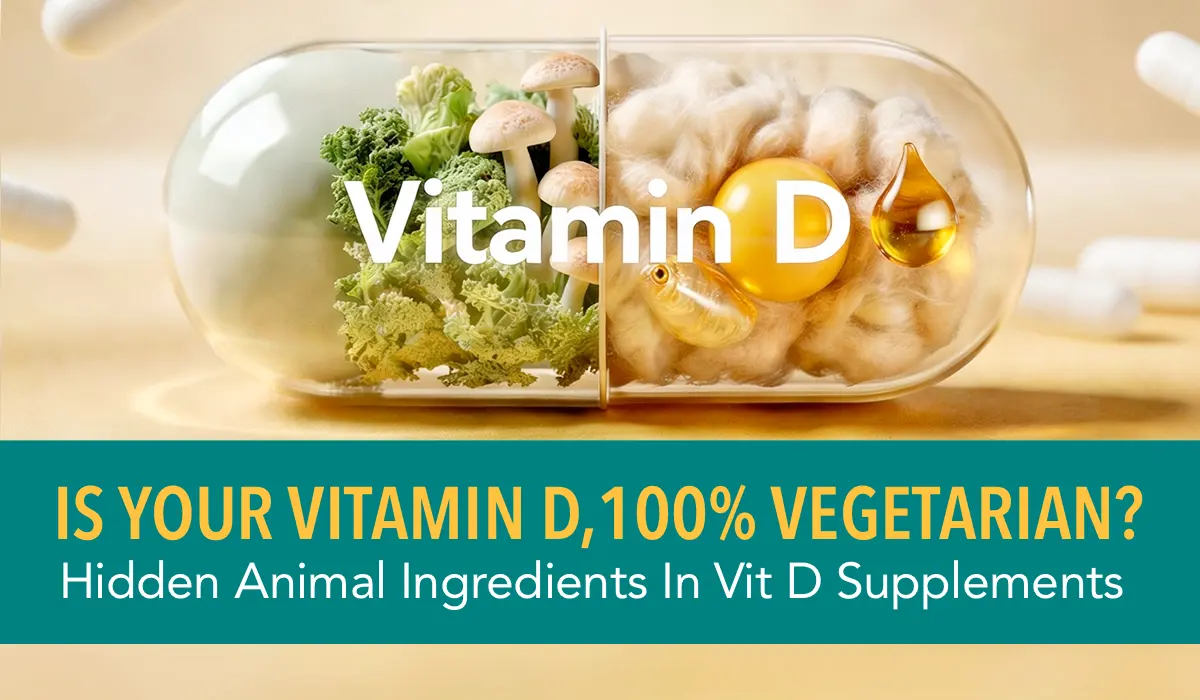
Vitamin D is a vital nutrient that your body needs for calcium absorption, bone health, immune function, and overall metabolic balance. Your body gets it from sunlight exposure and specific foods, but those may not be enough. In India, vitamin D deficiency is widespread. It is fueled by factors like genetics, food habits, lifestyle, and even pollution levels. Supplementation often becomes necessary.
A section of these supplement users are vegetarians and vegans. But the irony is, even after choosing a plant-based diet and taking vegetarian supplements, there can be hidden animal ingredients in the vitamin D supplement that you are using.
In several such products, Vitamin D3, the commonplace supplemental form, is derived from lanolin (sheep’s wool) or other animal sources. But the product label often does not reflect the truth. Without realizing it, you may be consuming animal-derived ingredients daily.
As a consumer, you have the right to know exactly what goes into your supplements. Wouldn’t it be great to know that your supplements are as clean and plant-based as your diet?
VitSupp brings you a 100% VEGAN Vitamin D3 supplement, made with Lichen, with vitamin K2 (MK-7). If you’re looking for a clean-label vitamin D supplement without any animal extracts – this is it.
Understanding Vitamin D and Its Forms
A fat-soluble nutrient, Vitamin D plays a major role in bone health, calcium absorption, and immune system function. Your body needs it for developing and maintaining healthy bones and teeth. Without adequate intake of vitamin D, the body struggles to absorb calcium, which puts you at risk of developing conditions like osteoporosis.
There are two major forms of Vitamin D:
- Vitamin D2 (ergocalciferol) – Mostly derived from plant-based sources like mushrooms, you also get it in some fortified foods. It is less bioavailable than vitamin D3, according to ScienceDirect research data.
- Vitamin D3 (cholecalciferol) – A highly bioavailable form, you find it mostly in animal sources like lanolin, cod liver oil, and egg yolks. It is what the most supplement brands prefer. It is also derised from plant based sources such as lichen, but very few brands offer that.
If you are following a vegan or vegetarian diet, finding truly vegetarian vitamin D supplements can be tough. Several supplements actually contain lanolin, a waxy substance in sheep’s wool, as a source.
Supplements containing lichen, a plant-based source of Vitamin D3, will better suit their needs. It grows in abundance on mountainsides, rocks, and trees, and so comes across as an environmentally conscious choice.
Confused between forms? Discover the difference between vitamin D2 vs D3 and how to choose the right option based on your dietary preferences.
What are the Common Animal Ingredients Found in Vitamin D Supplements?
Before you start looking for a suitable vegetarian vitamin D3 supplement, learn about the hidden animal ingredients in supplements. Several Vitamin D supplements contain animal-derived ingredients, even though they may be marketed as natural and vegetarian-friendly.
Common animal ingredients existing in OTC vitamin D3 supplements are:
1. Lanolin (Sheep’s Wool)
In several vitamin D supplements, you will find lanolin, a waxy substance taken from sheep’s wool. While it serves as a source of Vitamin D3 (cholecalciferol), it does not meet the needs of vegan and vegetarian users.
2. Cod Liver Oil
It is another widely used animal source of Vitamin D3 in supplements. While cod liver oil serves as a rich source of vitamin D and omega-3 fatty acids, it is not a vegetarian- or vegan-friendly supplement.
3. Gelatin
This is another commonplace animal-sourced ingredient that you can find in several vitamin D supplements. Gelatin is created by boiling the stomach, ligaments, tendons, and tissue linings of cattle or pigs. It helps form a solid capsule, but it isn’t vegetarian at all. Vegans and vegetarians should seek HPMC or vegan vitamin D3 capsules.
4. Beeswax and Other Additives
Some vitamin D supplements contain beeswax or other animal-sourced emulsifiers and stabilizers in their formulations. Beeswax, in particular, serves as the coating of tablets or soft gels, and emulsifiers help bind ingredients together in a stable form.
Why Does it Matter?
You must understand the ingredients used in your vegetarian vitamin D3 supplement. This is non-negotiable when you believe in living a sustainable lifestyle and want to make similar food choices, too. For many, this goes against their deeply held values. With premium-quality, Lichen-based Vitamin D3 supplements available, you do not have to put up with animal gelatin in vitamin D supplements.
Here’s a Quick Comparison Between Lichen vs. Lanolin
| Feature | Lichen | Lanolin |
| Source | Plant-based (Lichen) | Animal-based (Sheep’s Wool) |
| Vegan | 100% Vegan | Not Vegan (Contains Animal By-Products) |
| Bioavailability | Highly bioavailable (D3) | Effective, but not as bioavailable as D3 from Lichen |
| Sustainability | Environmentally sustainable, renewable | Unsustainable (sheep wool farming) |
| Ethical | Cruelty-free, plant-sourced | Animal-derived, not cruelty-free |
Why Most People Miss the Hidden Animal Ingredients?
Let’s have a look at the reasons behind people failing to identify animal-derived vitamin D3 in their supplements:
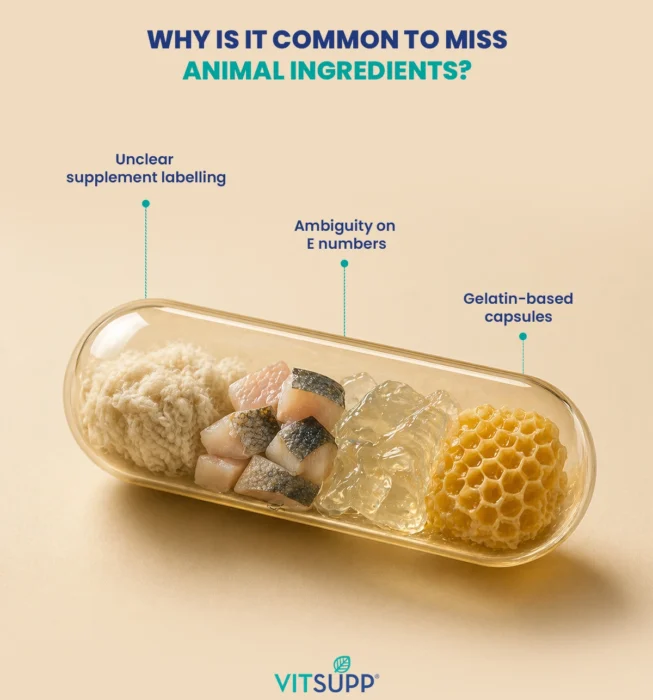
Lack of Clarity in Labeling
Some brands sell supplements with terms like “vegetarian” or “natural” printed on labels. However, they do not clearly mention if the products contain traces of animal-derived ingredients like lanolin, gelatin, or cod liver oil. If the Vitamin D3 contains lanolin (sheep’s wool), it is not a vegetarian vitamin D supplement. Using vague terms without specifying the source of ingredients can complicate things.
E-Numbers and Additives
E-numbers refer to food additives used to preserve or stabilize products. You may struggle to understand if that hints at animal-derived ingredients. For example, E470 is a popular emulsifier, and it can contain traces of animal fats. But in most cases, supplement labels do not clearly mention the details or the source. Similarly, brands often use ingredients like beeswax to manufacture vitamin D soft gels and capsules without a proper disclosure.
Gelatin-coated Capsules
Not many supplement buyers see an issue with the gelatin in capsules. However, the reality is that it comes from animal collagen, typically from animals like cows or pigs. When you do not check the supplement carefully, you unknowingly consume animal-based gelatin.
If you want to avoid supplements with animal-derived vitamin D3, switch to a more viable alternative. VitSupp offers a 100% Vegan, clean-label Vitamin D3 (Cholecalciferol) supplement in an MCT oil-based softgel, with no animal extracts.
How to Choose Truly Vegetarian Vitamin D Supplements?
To choose a vegetarian vitamin D3 supplement, you must have good knowledge of animal-derived and plant-based sources. A number of Vitamin D3 supplements often contain animal ingredients like lanolin. You should look for certain attributes when comparing options to ensure you can avoid hidden animal ingredients in vitamin D supplements.
Look for Lichen-Based Vitamin D3
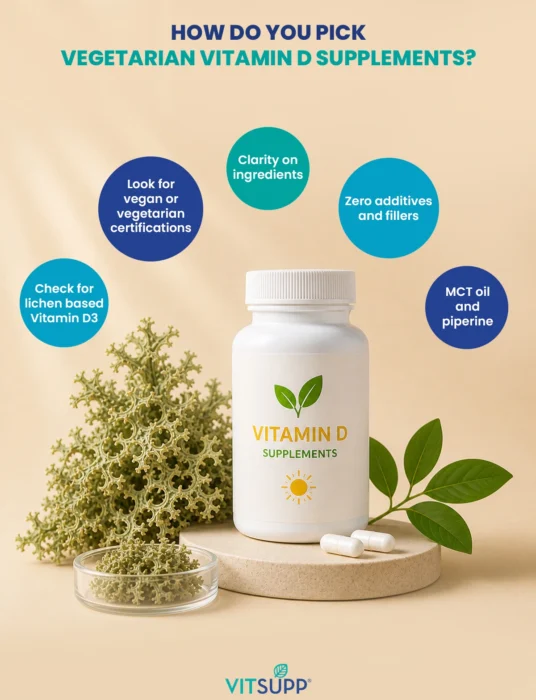
The first thing you can check is vitamin D3 vegetarian. Look for supplements that contain Lichen-based Vitamin D3. This is a plant-based source of cholecalciferol (Vitamin D3), an ideal alternative to lanolin. Lichen, which is a plant-based source of vitamin D3, scores well in bioavailability and effectiveness. Lichen-based Vitamin D3 is a plant-sourced solution that offers required support for calcium absorption, bone health, and immune system functions.
Check for Vegan or Vegetarian Certifications
When comparing vegetarian vitamin D3 supplements, check the label for vegan or vegetarian certifications. Check if the label clearly mentions “no gelatin” or if it uses HPMC capsules. The latter is made from plant cellulose. Also, look for the presence of animal extracts like beeswax in the composition.
Transparency on Ingredients
When looking for vegetarian vitamin D3 products, always read the ingredient list carefully. Brands using incomplete or vague descriptions like “additives” often try to mask the use of animal ingredients. Not every buyer is aware of what E-numbers signify, for example.
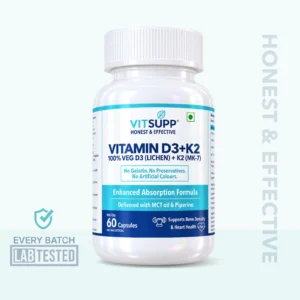
VitSupp’s Vitamin D3 + K2 supplement contains lichen-derived D3, vitamin K2, and no gelatin or lanolin in the formulation. You get pure vegetarian HPMC capsules, offered in an MCT oil base.
MCT Oil Base and Piperine
Your chosen supplement should have a healthy fat base, like MCT oil. The oil base helps in absorption, and the presence of piperine helps improve bioavailability.
No Additives and Fillers
Apart from animal gelatin in vitamin D supplements, look for unnecessary fillers, artificial colors, and preservatives. These are unnecessary and can affect the efficacy of the product. A clean-label supplement is the better choice.
Understanding sources and formulation matters. Explore how vitamin D absorption, carrier oils, and ingredient transparency impact the effectiveness of your supplement.
Who Should Choose Vegan Vitamin D3?
Vegan Vitamin D3, obtained from Lichen, is an apt choice for several groups of people with specific health and ethical considerations. Here’s who would benefit most from vegan vitamin D3:
1. Vegans & Vegetarians
If you follow a vegan or vegetarian lifestyle, ensure that your Vitamin D supplement aligns with your dietary and ethical choices. Traditional Vitamin D3 supplements often contain lanolin, derived from sheep’s wool. Vegan Vitamin D3, sourced from Lichen, a plant-based organism, ensures you don’t consume any animal-derived ingredients.
2. Ethically-Minded Consumers
Many people are becoming aware of the ethical implications of their purchases. If you embrace cruelty-free products and want to avoid animal exploitation, a vegan Vitamin D3 supplement aligns with such ethical practices. Vegan Vitamin D3 allows you to support your health without compromising your values.
3. People with Lactose Intolerance
For individuals with lactose intolerance or dairy allergies, some traditional Vitamin D3 supplements may not be suitable. These often contain animal-derived ingredients like lanolin or cod liver oil. Vegan Vitamin D3 offers a safe, non-dairy alternative to support bone health and immune function.
4. Health-Conscious Users Seeking Maximum Bioavailability
Lichen-based Vitamin D3 is considered more bioavailable and effective compared to its D2 counterpart. It is an ideal choice for people who want optimal bioavailability in their supplements. It provides the same benefits of Vitamin D without the risks or uncertainty of animal-based sources.
Mistakes to Avoid When Choosing Vegetarian Vitamin D Supplements
Do not rush when buying vegetarian vitamin D supplements. Take your time and analyze the key aspects to avoid buying animal-derived vitamin D3 products.
- Don’t overlook the source of vitamin D in the supplement or settle for vague descriptions. Ensure the vitamin D3 comes from vegetarian sources like lichen.
- It would be a mistake to choose a supplement based on high dosage. Your body can deal with a certain amount of vitamin D, and a range of 600 IU is generally considered safe.
- A vegetarian vitamin D3 supplement works better when there is a cofactor like vitamin K2. The latter plays a major role in calcium utilization in the body, so don’t overlook this.
- Ignoring the fillers, artificial colors, allergens, and preservatives in a vitamin D supplement is a big mistake. These ingredients can add to digestive issues and may have other side effects.
- Does the vitamin D3 supplement you are eyeing have an MCT oil or similar healthy fat base? Otherwise, the absorption may not be optimal. Without ingredients like piperine, the bioavailability may take a hit.
By using a careful approach and analyzing key parameters, you can buy a suitable vegetarian vitamin D3 supplement without animal extracts or unnecessary fillers.
Many people make the mistake of choosing the wrong supplement form. Learn why taking vitamin D3 alone may not always be enough and what to consider instead.
Why VitSupp’s Vegetarian Vitamin D3 Supplement Stands Apart?
VitSupp’s Vitamin D3 + K2 supplement stands tall in a crowd of similar-looking supplements.
Let’s find out why it is an ideal choice for those seeking vegan vitamin D sources.
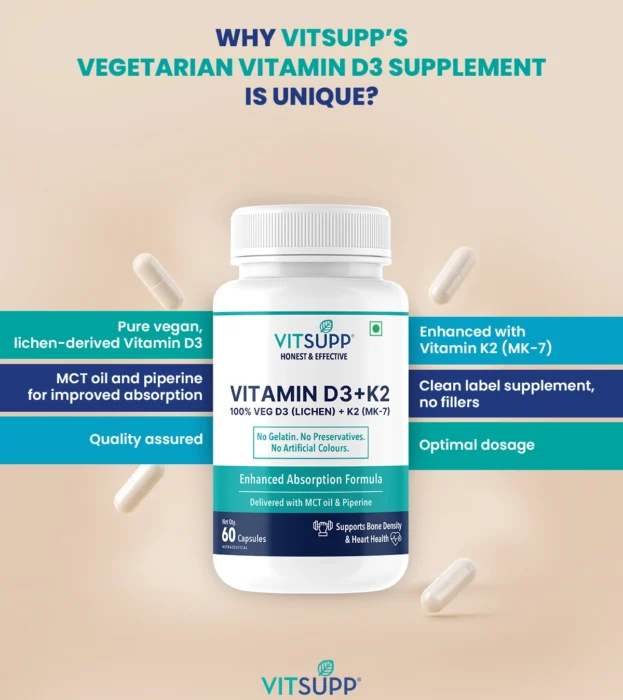
100% Vegan, Lichen-Based Vitamin D3
Unlike many Vitamin D3 supplements that contain lanolin, it uses 100% plant based vitamin D3, suited even for vegans. It is a sustainable and ethical alternative to animal sources of vitamin D3, which scores well on efficacy.
Enriched with Vitamin K2 (MK-7)
This vegetarian vitamin D3 supplement comes with Vitamin K2 (MK-7). This supports the utilization of the absorbed calcium in your body. This is necessary to avoid the risk of calcium getting deposited in the arteries. MK-7 is clinically proven to be more effective at activating osteocalcin, a protein that supports calcium binding to bones.
MCT Oil and Piperine for Better Absorption
This Vitamin D3 + K2 supplement has an MCT oil base and also contains Piperine extract. MCT oil is a fat-soluble carrier, and vitamin D is fat-soluble. So, it adds to vitamin D absorption, and Piperine helps improve the bioavailability of various nutrients, including Vitamin D. This combination helps your body absorb vitamin D3 easily for various functionalities.
Clean Label Supplement with No Additives
VitSupp brings a clean formulation with no artificial colors, preservatives, or fillers. The supplement is devoid of gluten, soy, and GMOs. It uses HPMC capsules, which are plant-based and suitable for vegans. So, you get ingredients your body actually needs, and nothing unnecessary. The labeling is clear, and you won’t get any vague or incomplete terms.
Assurance of Quality
Each batch of this Vitamin D3 + K2 supplement undergoes batch-testing for purity and potency. So, you get a product that undergoes extensive testing for efficacy and quality. You can even scan a QR code on the product label to access the batch-specific purity report. It also comes with FSSAI approval, and manufacturing takes place at a GMP and ISO 22000 & HACCP certified facility in India.
Balanced and Effective Dosage
Not every vitamin D3 supplement gets the balanced mix of key ingredients. VitSupp’s offering has an optimal dosage of Vitamin D3 (600 IU), Vitamin K2 MK-7 (45 mcg), and BioPerine/ black pepper extract (2.5 mg). Every capsule adheres to the recommended dietary allowance range set by the Indian Council of Medical Research.
These 100% vegetarian capsules are aimed at different types of users seeking a clean-label vitamin D supplement, without confusing variants or any animal extracts.
Vitamin D works best when supported by the right nutrients. Understand the importance of vitamin D and vitamin K togetherfor better utilization in the body.
Conclusion
Vitamin D deficiency is a widespread health problem, with NLM data showing approx 70%-90% Indians coping with it. Using suitable vitamin D3 supplements can be useful to deal with it. However, choosing the supplement is not only about meeting your health needs. It is also about using a product aligned with your ethical values and overall lifestyle. This is particularly applicable for vegetarians and vegans.
Finding a truly vegetarian vitamin D3 supplement can be tough, as brands often do not offer clarity on formulation, and some products contain animal ingredients. To make the right choice, you must be careful in selection and go for Lichen-based Vitamin D3 supplements that do not contain any animal byproducts like beeswax or gelatin. A vegan certification is something you should look for.
To avoid consuming animal-derived vitamin D3, you can choose VitSupp’s offering, a vegan, clean-label vitamin D supplement, without any allergens, fillers, and assurance of high-quality manufacturing and testing.
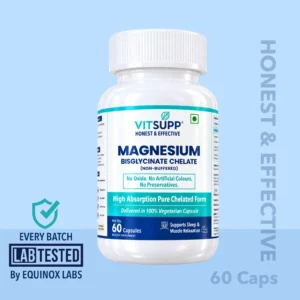
Looking to improve overall nutrient balance? Check out this guide on how to choose a magnesium supplementfor better daily support.
FAQs
1. Is Most Vitamin D3 Vegetarian?
No, the majority of Vitamin D3 is not vegetarian since the sources most often contain animal protein. Several Vitamin D3 supplements on the market contain animal ingredients like lanolin, a waxy substance made from sheep’s wool. It does not suit vegetarian or vegan consumers, despite serving as a good source of vitamin D3. For such users, it is better to use Lichen-based Vitamin D3 supplements. This plant-sourced alternative offers similar health benefits to lanolin-based products.
2. What is Lanolin-Derived Vitamin D3?
Lanolin-derived Vitamin D3 refers to a source obtained from the wool of sheep. These animals produce this waxy substance, which is secreted by the sebaceous glands. To make Vitamin D3, lanolin is processed through ultraviolet (UV) light. This turns it into the active form of Vitamin. This form of Vitamin D3 helps improve Vitamin D levels in the bloodstream. That’s why several brands use it in their supplements. Despite its popularity and efficacy, lanolin is an animal-derivedsource of vitamin D3, and vegans can’t use it.
3. How Do I Check if Vitamin D is Vegetarian?
To check if a vitamin D supplement you bought is vegetarian or not, carefully read the label. Check the source of the vitamin D used in that product, to start with. A lot of Vitamin D3 supplements have animal-derived vitamin D3, mostly taken from lanolin, which comes from sheep’s wool. A true vegetarian vitamin D3 supplement will most likely contain Lichen, a plant-based organism. Also, you should look for vegan certification on the packaging and check the formulation for any mention of animal extracts like beeswax and gelatin, etc.
4. What is the Difference Between Vegetarian and Vegan Vitamin D?
The main difference between vegetarian and vegan Vitamin D lies in the source of Vitamin D3. In many vegetarian vitamin D supplements, the source is lanolin, a substance acquired from sheep’s wool. Vegetarian users usually accept lanolin as an animal by-product, but that is not the case with vegans. Vegan Vitamin D3 is acquired from Lichen, a plant-based organism. This is a product that both vegans and vegetarians can use. Vegan Vitamin D must be free of any animal by-products.
5. How Can I Identify Hidden Animal Ingredients in Vitamin D Supplements?
To identify hidden animal ingredients in vitamin D supplements, you must be careful. Check the product label without rushing about it. Look for the source of the vitamin D, to start with. If it mentions lanolin, then there are animal ingredients. Products that are lichen-based and come with a vegan certification are likely to be clear. Additionally, you must look for ingredients like gelatin and beeswax. Sometimes, vitamin D capsules may use E-numbers (such as E901, E470) that may point to animal extracts.
6. What Should I Check on a Supplement Label to Confirm Its Vegetarian?
To find out whether a supplement contains vegetarian vitamin D3, look for specific keywords on the label and in the ingredient list. Check if the product contains Lichen-based Vitamin D3. It is acquired from plants and, therefore, is suitable for vegetarians. Avoid supplements that come with vague descriptions or ambiguity. Also, check the formulation for mentions like gelatin, which is animal-derived. Some may also contain beeswax. If you find any E-numbers on the product label, analyze them for better clarity.
7. Is Lichen Vitamin D3 Better for Vegetarians?
Yes, Lichen-based Vitamin D3 is usually better for vegetarians than supplements with animal-derived vitamin D3. Lichen is a plant-based organism, which makes it ideal for vegans and vegetarians seeking animal-free vitamin D sources. On the contrary, lanolin-based Vitamin D3 contains animal byproducts. Lichen-based Vitamin D3 scores well on both the bioavailability and health-benefit fronts. Vegetarians find it easy to meet their Vitamin D needs by choosing Lichen-based Vitamin D3 supplements, while maintaining their ethical values.
8. Are Gelatin Vitamin D Capsules Vegetarian?
No, gelatin capsules are not vegetarian. Gelatin is made by using the collagen found in animal bones, skins, and tissues, generally from animals like cows or pigs. So, any Vitamin D supplement that comes in a gelatin capsule cannot be called a vegetarian vitamin D3 supplement. Vegans and vegetarians should look for capsules made from HPMC (Hydroxypropyl Methylcellulose). This substance contains plant cellulose and no hidden animal extract. If you are unsure about animal extracts, read the label for any mention of gelation, beeswax, etc.
9. What Certifications Indicate a Supplement is Truly Vegetarian?
To ascertain that you buy a truly vegetarian vitamin D3 supplement, look for vegan certification on the product label. That ensures the supplement is entirely free from any animal products, including animal-derived Vitamin D3 (lanolin), gelatin capsules, and beeswax. If the supplement has vegetarian certification, it will not have any meat or poultry ingredients. However, such supplements still may come with animal by-products like lanolin or gelatin. Apart from these, check if the product is free of GMOs and contains organic ingredients. These ensure the formulation does not contain harmful chemicals.
10. How Do I Choose a Truly Vegetarian Vitamin D Supplement?
To choose a truly vegetarian Vitamin D supplement, check the source of Vitamin D and the capsule material. Find out if there are hidden animal ingredients in the supplement. Look for products that include Lichen-based Vitamin D3 and not lanolin. It is plant-based and well-suited for vegetarians and vegans. The capsule should likely have an HPMC (Hydroxypropyl Methylcellulose) base. Do not choose any gelatin-based capsule. It is ideal that you go for supplements that have Vegan or Vegetarian certifications. Overall, you will have to read the product label carefully. If necessary, you can enquire the brand about ingredient details.