
Magnesium is one of the most important minerals in your body. It plays a role in normal muscle function, nervous system function, energy production, and bone health. It is no surprise that so many people search for a magnesium supplement when they are dealing with poor sleep, slow muscle recovery, or ongoing stress.
But here is where most people get stuck. Choosing a good magnesium supplement is not just about the number printed on the front of the bottle. The form of magnesium used inside the capsule matters just as much, since different forms come with different absorption rates and different effects on your digestion.
This brings us to an important question that most labels never really answer clearly: what does non-buffered magnesium bisglycinate actually mean, and how can you verify whether the supplement you are holding truly contains it?
Understanding Magnesium Bisglycinate
Before getting into buffered versus non-buffered forms, it helps to understand what magnesium bisglycinate actually is.
What Is Magnesium Bisglycinate and What Makes This Form Different?
Magnesium bisglycinate is nothing but a form of magnesium. In this case, magnesium is attached to glycine, which is basically an amino acid. This chemical process creates a chelated magnesium compound. This compound helps keep the magnesium bound in a stable form. Because of this structure, magnesium bisglycinate is often used in supplements designed for better absorption and gentle digestive support.
Magnesium is an essential mineral; it supports:
- Normal human nervous system function
- Proper muscle contraction as well as relaxation
- Healthy and proper electrolyte balance
Different magnesium forms have different absorption and tolerance profiles. Understanding the form used helps you choose a better magnesium supplement.
What Does Chelated Magnesium Mean?
In simple words, Chelation means that magnesium is attached to another molecule, rather than existing on its own in a raw mineral state. In the case of magnesium bisglycinate, magnesium is bound with glycine molecules. Glycine is an amino acid, and this pairing creates a stable, well-recognized magnesium compound.
The main purpose of this chelation process is really straightforward. It creates a form of magnesium that the human body can recognize and utilize efficiently, rather than one it has to work harder to break down and absorb. This is exactly why chelated magnesium bisglycinate is often discussed separately from older as well as more basic forms of magnesium.
Understanding Absorption and Elemental Magnesium
Not all magnesium supplements behave the same way, even when the label says “magnesium” in bold letters.
There are several supplemental forms available today, including magnesium oxide, magnesium citrate, and magnesium bisglycinate. Each of these differs in three important ways: elemental magnesium content, absorption characteristics, and digestive tolerance.
Some forms deliver a large amount of magnesium on paper but are poorly absorbed, while others deliver a smaller amount that the body actually uses more effectively.
Elemental Magnesium vs Magnesium Compound
This is where a lot of confusion happens. Consumers often mix up two different numbers: the total magnesium compound amount and the actual elemental magnesium provided.
For example, a product may list “magnesium bisglycinate chelate” at a certain weight, but only part of that weight is actually magnesium. The rest of the compound is made up of the glycine molecules it is bound to.
| Label Term | What It Refers To | Common Misunderstanding |
| Magnesium Bisglycinate Chelate (total weight) | The full compound weight, including magnesium bound to glycine molecules | Assumed to be the total amount of magnesium the body receives |
| Elemental Magnesium | The actual magnesium content within that compound, excluding glycine | Often smaller than the total compound weight, but this is the number that matters |
| Large mg Number on Label | Usually reflects total compound weight, not usable magnesium | Perceived as “more magnesium,” when it may mean more glycine, not more mineral |
So a bottle claiming a large number in milligrams may still provide a fairly modest amount of elemental magnesium once you account for this.
The key message here is simple: a higher number on the label does not always mean a better magnesium formulation. What matters is how much elemental magnesium you are getting, and in what form.
Different magnesium forms support different health needs. Read our complete guide to compare absorption, benefits, and the best uses for each type.
What Is Non-Buffered Magnesium Bisglycinate? Understanding the Meaning Behind the Term
Non-buffered magnesium bisglycinate means that magnesium is provided primarily as magnesium bisglycinate. That is, without the formula relying on additional magnesium sources, such as magnesium oxide, to boost the total magnesium amount.
In simple terms, a pure magnesium bisglycinate supplement is built to preserve the original chelated magnesium form. It does not combine that form with other magnesium compounds just to make the label number look higher.
Buffered vs Non-Buffered Magnesium Bisglycinate: Why Some Products Use Buffered Forms
Some magnesium bisglycinate supplements on the market are buffered, which means they combine magnesium bisglycinate with another magnesium source.
| Feature | Non-Buffered Magnesium Bisglycinate | Buffered Magnesium Bisglycinate |
| Magnesium source | Magnesium bisglycinate only | Magnesium bisglycinate + another magnesium form |
| Added ingredients | No additional magnesium source | May include magnesium oxide |
| Label interpretation | Easier to identify | Requires closer label checking |
| Formulation focus | Maintaining chelated magnesium form | Increasing overall magnesium content |
Why Do Manufacturers Use Buffered Magnesium?
There are practical reasons some brands choose buffered formulas. Certain magnesium compounds, like magnesium oxide, contain a higher percentage of elemental magnesium by weight.
Mixed with magnesium oxide, a bisglycinate formula can show a bigger number on the front of the label, even though a portion of that magnesium comes from a form with a much lower absorption rate.
The consumer takeaway is straightforward: understanding the ingredient list helps you know what type of magnesium you are actually choosing, rather than relying on the headline number alone.
How to Verify Magnesium Bisglycinate on a Supplement Label: A Practical Guide Before Buying

You will be able to identify a genuine magnesium bisglycinate supplement by checking four important areas.
1. Check the Listed Magnesium Form
Look for specific, named forms such as magnesium bisglycinate, magnesium bisglycinate chelate, or magnesium glycinate chelate. Be cautious with vague descriptions like “magnesium blend” or “proprietary magnesium complex,” since these terms do not tell you what you are actually taking. Transparent ingredient names help you understand the exact form of magnesium being used, which is the whole point of checking the label in the first place.
2. Check Whether Magnesium Oxide Is Added
Look carefully at the full ingredient list, not just the front of the bottle. If the formula lists both magnesium bisglycinate and magnesium oxide, you are looking at a buffered formula rather than a pure magnesium bisglycinate supplement. If you are specifically looking for a magnesium supplement without magnesium oxide, this is the line to check first.
3. Understand the Elemental Magnesium Amount
A quality magnesium supplement should clearly state both the magnesium compound used in the formula along with the elemental magnesium delivered per serving. This distinction matters the most because it lets you compare products accurately, instead of comparing compound weights that may include non-magnesium components like glycine.
4. Review Quality and Manufacturing Information
Apart from the magnesium form itself, a trustworthy supplement must offer complete ingredient transparency, clear manufacturing details, along with relevant quality certifications. In India, these certification includes FSSAI compliance, GMP manufacturing, and non-GMO status where applicable. Though these details do not change the chemistry of the magnesium, but they do reflect how seriously a brand takes their quality control procedure.
Non-Buffered Magnesium Bisglycinate Benefits: Why Consumers Choose This Magnesium Form
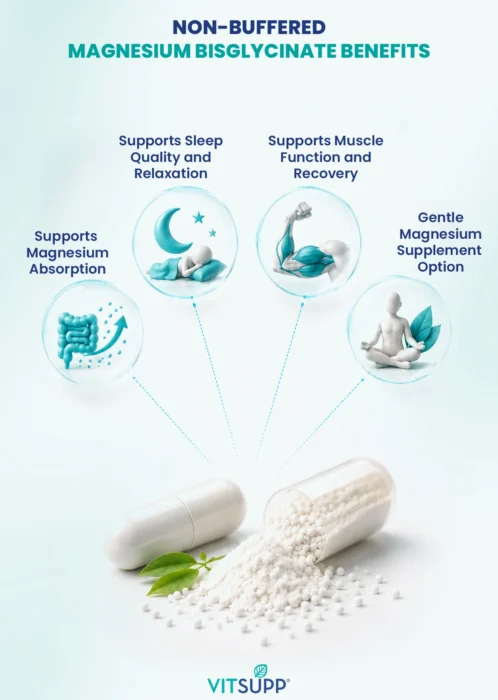
When magnesium is kept in its pure, non-buffered form, its natural benefits tend to come through more clearly. Here is why so many consumers specifically look for this form over others.
1. Supports Magnesium Absorption
Chelated magnesium forms are designed to support magnesium delivery more effectively compared with some less absorbable forms, since the glycine attachment helps the compound move through the small intestine in a way the body readily recognizes.
2. Supports Sleep Quality and Relaxation
Magnesium contributes to normal nervous system function, which is part of why it is closely associated with rest and relaxation. Magnesium bisglycinate is commonly chosen in magnesium for sleep formulations because it pairs magnesium with glycine, an amino acid also associated with calm, restful states.
3. Supports Muscle Function and Recovery
Magnesium plays an important role in normal muscle function and electrolyte balance in human body. Both of these functions are relevant for anyone dealing with muscle tightness, cramping, or slower recovery after physical activity.
4. Gentle Magnesium Supplement Option
Many consumers prefer magnesium bisglycinate because it is generally considered a gentler form compared with certain other magnesium compounds that are more likely to cause loose stools or digestive discomfort.
Magnesium Bisglycinate vs Magnesium Glycinate
The terms magnesium glycinate and magnesium bisglycinate are often used interchangeably on supplement labels, which can be confusing for consumers.
Both terms refer to magnesium combined with the amino acid glycine. The term magnesium bisglycinate is the more chemically precise name because it describes a magnesium ion chelated with two glycine molecules (“bis” meaning two).
In the dietary supplement industry, products labeled as magnesium glycinate and magnesium bisglycinate generally refer to the same type of magnesium chelate. However, it’s always worth reviewing the ingredient label carefully, as the quality and composition of products marketed under these names can vary between manufacturers.
Magnesium Bisglycinate vs Magnesium Glycinate
| Feature | Magnesium Bisglycinate | Magnesium Glycinate |
| Chemical description | Magnesium chelated with two glycine molecules | Common name used for magnesium combined with glycine |
| Scientific precision | More chemically precise term | More commonly used commercial term |
| Label usage | Often seen on technical specifications and premium formulations | Widely used on consumer supplement labels |
| Underlying ingredient | Generally refers to the same magnesium-glycine chelate | Generally refers to the same magnesium-glycine chelate |
| Consumer takeaway | In most supplements, there is no practical difference in the name alone | Focus on the ingredient quality rather than the name |
More Important Than the Name: Is It Buffered or Unbuffered?
Whether a product is labeled magnesium glycinate or magnesium bisglycinate is often less important than how the ingredient has been formulated.
Some products are buffered, meaning magnesium bisglycinate is blended with magnesium oxide or other magnesium salts. Others use unbuffered magnesium bisglycinate, where the ingredient is supplied as a single chelated form without added magnesium oxide.
For consumers looking for greater transparency, it’s worth checking whether the manufacturer clearly discloses:
- The exact form of magnesium used
- Whether the product is buffered or unbuffered
- The amount of elemental magnesium provided per serving
At VitSupp, we use unbuffered magnesium bisglycinate chelate, with no added magnesium oxide or blended magnesium salts, so you know exactly what you’re getting.
Choosing a Clean Magnesium Supplement: The VitSupp Approach
Understanding these magnesium forms helps you make a more informed choice, and it is exactly the kind of thinking VitSupp builds its formulations around.
A thoughtfully designed magnesium supplement should focus on meaningful ingredients, transparent labeling, a high-quality magnesium form, and vegetarian-friendly delivery.
VitSupp Magnesium Complete is built on Magnesium Bisglycinate Chelate, delivered in vegetarian HPMC capsules, with no added magnesium oxide. It reflects a clean-label formulation approach: one clear magnesium form, no unnecessary additions, and nothing on the label you cannot easily understand.
Final Checklist: How to Choose Magnesium Bisglycinate
Before you buy, run through this quick checklist. It brings together everything covered above into a few simple checks you can do right on the label.
- Check the exact magnesium form listed on the label
- Look for magnesium bisglycinate chelate specifically, this is a must
- Another important thing is to check whether magnesium oxide is added alongside it
- Understanding the elemental magnesium amount, not just the compound weight is another important aspect of magnesium supplements
- Before selecting review certifications and manufacturing standards properly, such as FSSAI and GMP
- Choose transparent, clean-label formulations that you can clearly understand
Conclusion
Magnesium supplements are not all the same, even when they claim to solve the same problems of poor sleep, stress, or muscle recovery. The mineral itself is only part of the story. The magnesium form, the transparency of the ingredient list, and the overall formulation approach all play a role in what you are actually putting into your body.
This is exactly why understanding terms like non-buffered magnesium bisglycinate is a must. It is not just about technical language for the sake of it. It will give you a practical way to read any supplement label, ask the right questions whenever necessary. It will also help you recognizing the difference between a formula built around one clean magnesium form and one that leans on additional sources like magnesium oxide to inflate the numbers.
Once you understand what to look for, choosing a magnesium supplement becomes a lot less confusing.
If you would like to explore a magnesium formulation built with this same clarity in mind, VitSupp‘s Magnesium Complete is scientifically designed with a focus on bioavailability, transparency, and clean-label nutrition, as advised by your healthcare professional.
Frequently Asked Questions
1. What is non-buffered magnesium bisglycinate?
Non-buffered magnesium bisglycinate refers to a magnesium supplement where magnesium is provided primarily through the magnesium bisglycinate compound itself, without additional magnesium sources mixed in to raise the total magnesium content. In other words, the formula relies on the chelated magnesium bisglycinate form on its own, rather than combining it with something like magnesium oxide to boost the number on the label. This makes non-buffered magnesium bisglycinate a more straightforward, single-source form of magnesium supplementation.
2. Why do some magnesium bisglycinate supplements contain magnesium oxide?
Some manufacturers add magnesium oxide to a magnesium bisglycinate formula because magnesium oxide contains a higher percentage of elemental magnesium by weight compared to bisglycinate. Blending the two allows a brand to display a larger total magnesium figure on the front of the label. This is often described as a buffered formula, and while it is not inherently unsafe, it does mean the product is not pure magnesium bisglycinate, and part of the magnesium you are getting comes from a form with a different absorption profile.
3. Does non-buffered magnesium bisglycinate provide elemental magnesium?
Yes, non-buffered magnesium bisglycinate does provide elemental magnesium, though generally in smaller amounts per capsule compared to buffered versions, since it is not combined with a higher-yield source like magnesium oxide. A well-labeled product should clearly state both the total magnesium bisglycinate chelate amount and the elemental magnesium it delivers, so you can see exactly how much usable magnesium you are consuming per serving.
4. Can you identify a non-buffered magnesium bisglycinate supplement by reading the ingredient list?
In most cases, yes. The ingredient list is the most reliable place to check. If magnesium bisglycinate or magnesium bisglycinate chelate is the only magnesium-related ingredient listed, the product is likely non-buffered. If you see magnesium oxide listed alongside it, or vague terms like “magnesium blend” or “proprietary magnesium complex,” that is a sign the formula has been buffered or is not fully transparent about its magnesium sources.
5. What should you look for on a non-buffered magnesium bisglycinate supplement label?
You need to look for a clearly named magnesium form, such as magnesium bisglycinate chelate, along with a stated elemental magnesium amount per serving. The ingredient list should not include magnesium oxide or unnamed magnesium blends. It also helps to check for manufacturing transparency, such as GMP certification and FSSAI compliance in the Indian market. Brands like VitSupp build their labels around this kind of clarity, stating the exact compound and elemental magnesium amount rather than leaving consumers to guess.
6. Why do manufacturers use buffered magnesium bisglycinate?
In general manufacturers use buffered magnesium bisglycinate to increase the total magnesium figure shown on the label. It is manufactured this way because combining forms can make the product appear more potent at a glance. It can also be a cost consideration, as magnesium oxide is generally less expensive to produce than fully chelated magnesium bisglycinate. Understanding this helps you read past the marketing number and focus on the actual composition.
7. Is non-buffered magnesium bisglycinate easier to absorb than buffered forms?
Chelated magnesium forms like bisglycinate are generally considered easier for the body to recognize and utilize compared to less absorbable forms such as magnesium oxide. In a non-buffered formula, since the magnesium is not diluted with a harder-to-absorb compound, the overall absorption profile tends to stay closer to that of pure magnesium bisglycinate rather than being pulled down by a lower-absorption additive.
8. Why do non-buffered magnesium bisglycinate supplements provide less elemental magnesium?
Non-buffered magnesium bisglycinate supplements provide less elemental magnesium because as a compound, magnesium bisglycinate includes glycine molecules alongside the magnesium itself. Also, glycine makes up a meaningful portion of that total weight. Without an additional high-yield source like magnesium oxide added in, the elemental magnesium per capsule is naturally lower than in a buffered blend. This is not a flaw. It simply reflects the compound’s natural composition, which is why elemental magnesium content matters more than the total compound weight.
9. What certifications indicate a high-quality magnesium bisglycinate supplement?
You must look for GMP manufacturing certification, FSSAI compliance for products sold in India, along with non-GMO status wherever applicable. These certifications do not describe the magnesium form itself though. But they do reflect manufacturing standards, quality control, and regulatory accountability. VitSupp’s Magnesium Complete, for instance, is formulated to meet these standards while keeping the ingredient list itself simple and transparent.
10. Is magnesium bisglycinate the same as magnesium glycinate?
These terms are commonly used interchangeably, and both refer to magnesium bound to glycine molecules. Magnesium bisglycinate is the more precise term, since it specifies magnesium attached to two glycine molecules. In practical, everyday use, though, magnesium glycinate supplements and magnesium bisglycinate supplements typically refer to the same chelated magnesium compound.