You turn over a vitamin D bottle and find “cholecalciferol” in the ingredient list. Another product says “ergocalciferol.” A quick search tells you that Calciferol is a general name for vitamin D, while ergocalciferol and cholecalciferol identify its two main forms. Are these different nutrients, or different names for the same thing?
Vitamin D is commonly known as calciferol. Its two main forms have more specific names: vitamin D2 is ergocalciferol, and vitamin D3 is cholecalciferol.
Understanding these names helps you read beyond the front of a supplement bottle. They identify the vitamin’s form, while other label details explain its source, amount, and suitability for your dietary preferences.
Here is how to make sense of the terminology without needing a chemistry background.
What Is the Chemical Name of Vitamin D?
Calciferol is a common general name for vitamin D. However, vitamin D describes a group of related compounds rather than a single molecule with one chemical formula.
For supplement labels, the most useful distinction is between D2 and D3. Ergocalciferol identifies D2, while cholecalciferol identifies D3. These are established names used in scientific and ingredient terminology.
Other similar-sounding names describe compounds formed when the body processes vitamin D.
| Name | Meaning | Where You May Encounter It |
| Calciferol | Common general name for vitamin D | Educational content |
| Ergocalciferol | Vitamin D2 | Supplement and medicine labels |
| Cholecalciferol | Vitamin D3 | Supplement and medicine labels |
| Calcidiol or calcifediol | 25-hydroxyvitamin D3 | Clinical information and metabolism explanations |
| Calcitriol | Active vitamin D3 metabolite | Clinical information and prescription medicines |
If you searched for “vitamin D scientific name” or “another name for vitamin D,” calciferol answers the general question. For a specific ingredient, look for ergocalciferol or cholecalciferol.
Vitamin D also has no “full form” in the way an abbreviation does. The letter D is its vitamin designation.
Ergocalciferol and Cholecalciferol: Understanding D2 and D3
The words may look complicated, but their purpose on a label is straightforward.
1. Ergocalciferol Is Vitamin D2
Vitamin D2 is associated with fungi and yeast. Commercial production commonly involves exposing ergosterol, a compound found in these organisms, to ultraviolet light.
You may encounter ergocalciferol in dietary supplements, fortified foods and prescribed products. Its presence does not mean a product is ineffective or unsuitable.
2. Cholecalciferol Is Vitamin D3
The vitamin D3 chemical name is cholecalciferol. You may also see the spelling “colecalciferol,” particularly in medical information.
D3 is the form your skin produces following suitable sunlight exposure. Supplement ingredients can come from animal-derived sources, such as lanolin from sheep’s wool, or animal-free sources, such as lichen.
| Label Detail | Vitamin D2 | Vitamin D3 |
| Chemical name | Ergocalciferol | Cholecalciferol |
| Common supplement sources | UV-exposed yeast or fungi | Lanolin or lichen |
| Produced by human skin | No | Yes |
| Ingredient source | Usually from fungi or yeast | From lanolin or lichen; VitSupp uses vegetarian lichen-derived D3 |
Does D3 Work Better Than D2?
Both forms can increase blood vitamin D levels. A 12-week randomised trial involving South Asian and white European women found that D3 was more effective than D2 at raising total 25-hydroxyvitamin D when provided at the same daily amount through fortified foods.
That finding concerns a blood marker under the conditions studied. It does not mean D2 has no value, or that every D3 product offers the same results.
For a consumer, the useful first step is identifying the form. Next, check its source, amount, and directions.
Vitamin D Chemical Formula and Structure Explained Simply
There is no single vitamin D chemical formula that accurately represents every form.
The formulas of its two main forms are:
| Vitamin D Form | Chemical Name | Molecular Formula |
| D2 | Ergocalciferol | C₂₈H₄₄O |
| D3 | Cholecalciferol | C₂₇H₄₄O |
These formulas show the number of carbon, hydrogen and oxygen atoms in each molecule. Vitamin D2 contains one more carbon atom than D3.
In terms of vitamin D classification, these compounds belong to the secosteroid family. This means they are related to steroid structures but have an open ring. Their side-chain structures also differ.
You do not need to memorise a cholecalciferol structure diagram to compare supplements. The chemical name provides the more useful everyday clue.
A molecular formula also cannot tell you whether the ingredient came from lichen or lanolin, whether the capsule contains gelatin, or whether a finished batch has been tested. Those questions require additional label information.
Why Is Vitamin D Called the Sunshine Vitamin?
Vitamin D is called the sunshine vitamin because the skin can make D3 after exposure to ultraviolet B, or UVB, radiation.
The process begins with a compound in the skin called 7-dehydrocholesterol. UVB exposure converts it into previtamin D3, which then becomes vitamin D3.
However, living somewhere sunny does not establish how much vitamin D an individual produces.
Skin exposure, age, cloud cover and skin pigmentation can influence production. People with darker skin may produce less vitamin D under comparable sunlight conditions. Sunlight through a window does not support this process because glass blocks the relevant UVB radiation.
An office worker who travels mainly by car may therefore have a different exposure pattern than someone who regularly spends time outdoors.
No universal number of minutes in the sun suits everyone. Avoid using the “sunshine vitamin” nickname as a reason to abandon sun protection or assume your vitamin D status is adequate.
Calcidiol and Calcitriol: What Happens After Vitamin D Enters Your Body?
The vitamin D in a supplement isn’t yet in its active hormonal form. The body processes it through several steps. Understanding these steps explains why supplement labels and blood-test reports use different names.
1. The Liver Produces a Circulating Form
For D3, processing in the liver produces 25-hydroxyvitamin D3, also called calcidiol or calcifediol. D2 produces its corresponding 25-hydroxy metabolite. A routine vitamin D status test generally measures total 25-hydroxyvitamin D, including contributions from both forms.
Think of the supplement ingredient and the blood-test marker as different points in the same process. A bottle may list cholecalciferol, while a report lists 25(OH)D.
2. The Kidneys Produce the Active Form
The next major activation step occurs primarily in the kidneys. For D3, this produces calcitriol, or 1,25-dihydroxyvitamin D3.
Parathyroid hormone, calcium, and phosphate regulate its production. Routine status testing usually measures 25(OH)D rather than calcitriol.
3. “Active” Does Not Mean a Better Everyday Supplement
Calcitriol is also available by prescription for specific clinical needs. Its use can require monitoring and careful management of calcium intake and other medicines. Do not replace an ordinary D2 or D3 supplement with calcitriol because the word “active” sounds more effective. These products have different purposes.
Knowing the names helps you recognise that distinction; it does not replace medical guidance.
Where Do Vitamin D2 and D3 Come From?
A chemical name identifies the form. The source tells you where the ingredient comes from.
Food Sources and Fortified Foods
Fatty fish, such as salmon and mackerel, provide vitamin D. Egg yolks contain smaller amounts. Mushrooms can provide D2, with amounts varying according to factors such as UV exposure.
Some milk products, plant drinks and breakfast cereals are fortified with vitamin D. Check the label rather than assuming that every product in these categories contains it.
For example, two similar-looking plant drinks may differ in their added nutrients. “Plant-based” describes the product’s ingredients, but it doesn’t automatically mean it supplies vitamin D. Check the nutrition label to confirm whether it has been added and how much it provides.
Supplement Sources
Supplement D2 commonly comes from UV-exposed yeast. D3 can be produced from lanolin or sourced from lichen.
The important distinction is that lichen-derived D3 and lanolin-derived D3 are both cholecalciferol. The chemical name alone cannot separate them.
If avoiding animal-derived ingredients matters to you, look for an explicit source statement.
A label that only says “vitamin D3” leaves this question unanswered. The manufacturer should be able to clarify the ingredient source and the finished product’s dietary suitability.
How to Read a Vitamin D Supplement Label
Once you understand the terminology, a supplement label becomes easier to assess. Read these details together rather than relying on one prominent claim.
1. Identify the Form
Look for wording such as:
- Vitamin D2 as ergocalciferol
- Vitamin D3 as cholecalciferol
A front label may simply say “vitamin D.” The detailed ingredient or nutrition panel should provide more information.
This is where knowing the vitamin D chemical name becomes useful: you can recognise the form even when the longer name appears without a familiar abbreviation.
2. Check the Ingredient Source
Look for source wording such as “from lichen” or “from lanolin.”
For illustration, “Vitamin D3 as cholecalciferol from lichen” answers two different questions:
| Label Wording | Question It Answers |
| Vitamin D3 / cholecalciferol | Which form is present? |
| From lichen | Where does the ingredient come from? |
If the source is not stated, ask rather than guessing from the chemical name.
3. Read the Amount Per Serving
Vitamin D amounts may appear in micrograms, written as mcg or µg, and international units, written as IU.
Check whether the amount refers to one capsule or a serving containing several capsules. Comparing “per capsule” on one bottle with “per serving” on another can create a misleading impression.
1 mcg of vitamin D equals 40 IU, so 15 mcg is 600 IU. This conversion helps you interpret labels. It does not determine your individual requirement.
4. Check the Capsule Shell
The vitamin’s source and the capsule shell are separate ingredients.
For a vegetarian or vegan preference, review both. A source statement about D3 does not answer every question about the finished product.
5. Review Directions and Documentation
Read the recommended use, storage instructions and relevant precautions. Check other supplements you take for overlapping vitamin D.
Where testing documents are available, check which product and batch they cover. A report is most useful when you can connect it to the bottle you are buying.
Does the Chemical Name Tell You Which Supplement Is Right for You?
The chemical name helps you understand an ingredient, but cannot establish your personal need.
Vitamin D supports calcium absorption, normal bone maintenance, muscle function and the immune system. These roles do not mean that taking additional vitamin D will improve every symptom or provide extra benefits when intake is already adequate.
Your diet, existing supplements, medicines and health circumstances also matter. Discuss supplementation with a healthcare professional if you have a relevant medical condition or are already receiving vitamin D treatment.
Use the label to understand the product. Use individual guidance to determine whether it fits your needs.
What Form of Vitamin D Does VitSupp Use?
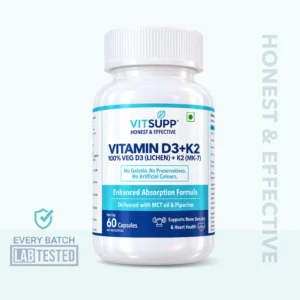
VitSupp Vitamin D3 + K2 uses Vitashine® Vitamin D3 as cholecalciferol from lichen.
Its published product information lists:
- Vitamin D3: 600 IU per capsule
- BioEssence® Vitamin K2 as MK-7: 45 mcg per capsule
- A vegetarian HPMC capsule shell
- The ingredients include MCT oil powder and standardised piperine extract.
This provides a practical example of reading beyond the nutrient name. “Cholecalciferol” identifies D3, “from lichen” identifies its source, and the per-capsule amount explains how much is supplied.
The capsule shell is disclosed separately, allowing readers to assess that part of the product too.
These details help you understand the formulation without relying on broad promises. For the most relevant information, review the current pack, usage directions and available product documentation.
Explore the ingredient details of VitSupp Vitamin D3 + K2 to see how its form, source and amount are presented.
Know the Name, Then Read the Whole Label
Calciferol is the common name for vitamin D. Ergocalciferol is D2, and cholecalciferol is D3. Calcidiol and calcitriol describe later stages of vitamin D processing.
These distinctions turn unfamiliar words into useful information. However, the name is only the starting point.
Before choosing a supplement, read its form, source, amount per serving, capsule ingredients and directions together. A clearly disclosed label helps you understand what you are buying and discuss its suitability with a healthcare professional.
Frequently Asked Questions
1. What Is the Chemical Name of Vitamin D?
Vitamin D is commonly known as calciferol. Its two main forms are ergocalciferol (D2) and cholecalciferol (D3). On supplement labels, these specific names help identify the ingredient’s form.
2. Is Calciferol the Same as Vitamin D3?
Calciferol is commonly used as a general name for vitamin D, so it does not reliably identify D3 by itself. Cholecalciferol is the specific name to look for when identifying vitamin D3. Always check the full ingredient wording.
3. What Is the Difference Between Ergocalciferol and Cholecalciferol?
Ergocalciferol is D2; cholecalciferol is D3. They differ in molecular structure and common sources. Both can raise blood vitamin D levels. D3 may raise these levels more and maintain them longer, but this does not make it universally better for every individual or clinical purpose.
4. Why Is Vitamin D Called the Sunshine Vitamin?
The skin produces vitamin D3 following suitable UVB exposure. This explains the nickname. Production varies with exposure conditions and individual factors, so living in a sunny climate does not automatically establish adequate vitamin D status.
5. What Is the Chemical Formula of Vitamin D?
The formula depends on the form. Vitamin D2, or ergocalciferol, is C₂₈H₄₄O. Vitamin D3, or cholecalciferol, is C₂₇H₄₄O. Vitamin D describes a group of related compounds, so one formula cannot represent every member of the group.
6. Which Form of Vitamin D Does a Blood Test Measure?
A routine vitamin D status test generally measures total 25-hydroxyvitamin D, written as 25(OH)D. It includes metabolites derived from D2 and D3. This differs from a calcitriol test, which answers specific clinical questions.
7. Which Name Will I See on a Vitamin D Supplement Label?
You will commonly see cholecalciferol for D3 or ergocalciferol for D2. Some labels show both the vitamin designation and chemical name. Check accompanying details for the source and amount, since the chemical name does not disclose everything.
8. Is Cholecalciferol Vegetarian?
Its suitability depends on the source. Cholecalciferol can come from lanolin or lichen. For an animal-free preference, check the source statement, capsule shell and other ingredients rather than assuming that all products containing D3 are equivalent.
9. Is Cholecalciferol Natural or Synthetic?
“Cholecalciferol” identifies the molecule, not its complete production method. Supplement ingredients undergo processing, and sources vary. Ask the manufacturer for sourcing details; the words “natural” or “synthetic” alone do not establish quality, safety or suitability.
10. What Form of Vitamin D Does VitSupp Use?
VitSupp Vitamin D3 + K2 uses Vitashine® D3 as cholecalciferol from lichen. Its published information lists 600 IU D3 and 45 mcg BioEssence® K2 as MK-7 per vegetarian HPMC capsule. Review the current pack for directions.