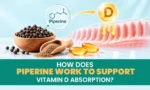

Piperine, the compound that gives black pepper its typical tangy flavor, is now used in Vitamin D3 supplement formulations, too. But why does it feature in the formulation?
Vitamin D is fat-soluble, and your small intestine absorbs it. Incidentally, the process depends on dietary fat, the form of Vitamin D used, and the formulation, too. Now, this is where piperine comes into the picture. Research indicates it can affect how the human body absorbs and metabolizes certain compounds.
So how does piperine actually work in vitamin D3 supplement formulations, and does that support bioavailability? While piperine is not a standalone Vitamin D absorption enhancer, it may work like a supporting ingredient in a thoughtfully designed Vitamin D3 formulation.
This blog explores piperine’s role in vitamin D3 absorption, what is piperine used for, and why it finds a place in VitSupp’s carefully designed, study-backed, vegan Vitamin D supplement formulation.
What Is Piperine, and What Does 95% Piperine Mean?
Black pepper is one of the most familiar spices people use in their kitchens. Its compound piperine gets attention beyond its culinary role. An alkaloid that adds to black pepper’s characteristic pungency, it has been studied for a possible role in improving the bioavailability of certain compounds.
Black Pepper and Piperine Extract Are Not the Same
The amount of piperine naturally present in culinary black pepper can vary. Factors like the pepper variety, growing conditions, and processing methods come into play. A supplement containing piperine extract uses a controlled process to offer users a certain amount of this compound.
A label stating “95% piperine” means that the extract has been standardized. It does not mean the total amount of piperine in the capsule but refers to the concentration of the active compound within the extract. Standardized extracts are common in nutraceutical formulations as they enable brands to maintain consistency in the amount of a specific compound.
Why Is Piperine Used in Supplements?
Research on Piperine has explored its interaction with compounds like curcumin, beta-carotene, and Coenzyme Q10. These studies indicate that the compound’s effect depends on its dose and the formulation. This does not mean that piperine increases the absorption of every nutrient in the same way.
In vegan and clean-label vitamin D3 supplements like VitSupp, piperine works as a supporting ingredient that helps with absorption.
Why Does The Complete Formulation Matter?
Vitamin D absorption does not depend on a single ingredient. There are factors like the interaction between the nutrient, the supplement format, the digestive environment, and individual factors.
So, a highly absorbable vitamin D supplement needs ingredients with a clear purpose. Some ingredients may support delivery, while others serve different roles within the formulation.
Vitamin D3 with piperine formulation is based on research around piperine’s role in supporting the bioavailability of certain compounds. However, direct evidence confirming that piperine increases Vitamin D absorption in humans is still limited. Piperine has been studied for its role in the bioavailability of selected compounds.
How May Piperine Support Bioavailability?
When you consume a nutrient or compound, the amount that reaches circulation depends on more than just the quantity present in the supplement. Factors like digestion, intestinal transport, metabolism, and elimination affect the amount of compound remaining available.
- Supporting Intestinal Availability
One way piperine bioavailability works is through its interaction with transport proteins in the intestine. The intestinal lining contains different transport systems that affect how ingredients move into and out of intestinal cells. P-glycoprotein is one such transporter that can move certain compounds back into the intestinal space.
Experimental research shows that piperine may inhibit P-glycoprotein activity. It could allow some compounds to remain available for absorption for a longer period. However, this is not to say that piperine increases the absorption of every nutrient similarly.
- Influencing Metabolism of Certain Compounds
Another area of research shows piperine’s mechanism of action with enzymes involved in metabolism. Enzymes like CYP3A4 help process many substances after they enter the body. Studies suggest that piperine can affect the activity of certain metabolic enzymes, thereby slowing the breakdown of some compounds and increasing their time in circulation.
- Affecting the Breakdown of Selected Compounds
Piperine may affect processes involved in the body’s natural elimination pathways. For some compounds, the body attaches molecules that make them easier to remove. This process, glucuronidation, affects the duration of certain substances remaining available.
Piperine may reduce glucuronidation of some compounds, and that may add to growing circulating levels in specific cases.
Its Link with Vitamin D
Vitamin D absorption involves its own mechanism because it is a fat-soluble vitamin. Current research supports piperine as a bioavailability enhancer for selected compounds. However, direct human evidence showing that piperine increases Vitamin D absorption is not substantial. Targeted Vitamin D-focused absorption studies would help establish the link.
Nevertheless, vitamin D3 supplements with piperine, like VitSupp, support the broader formulation approach.
Want to Learn More About Vitamin D Absorption?
Explore how carrier oils, dosage, and formulation can influence vitamin D absorption and bioavailability in supplements.
Read: Vitamin D Absorption: Role of Carrier Oils & Proper Dosage
What Have Human Studies Found About Piperine?
While lab research can help explain how piperine may influence absorption and metabolism, human studies show what happens when people actually consume a formulation.
Research on piperine shows that it does not act as a universal absorption booster, but the effect depends on the compound being studied, the dosage used, and the formulation. For example, in a well-defined vitamin D3 formulation like VitSupp, the presence of MCT oil may further enhance absorption.
While piperine’s presence helps improve absorption of curcumin and Coenzyme Q10, for Vitamin D, more human research is necessary.
| Compound Studied With Piperine | What Human Studies Show | Evidence Strength | What It Means |
|---|---|---|---|
| Curcumin | Piperine may significantly add to the bioavailability of curcumin in human studies. | Stronger human evidence | Piperine may improve the availability of certain compounds when used in the right formulation. |
| Coenzyme Q10 | Studies have explored piperine’s role in supporting CoQ10 bioavailability. | Emerging human evidence | Piperine may help improve the availability of selected compounds. |
| Vitamin D | Direct human studies proving that piperine increases Vitamin D absorption remain limited. | Limited evidence | Piperine can serve as a supporting ingredient in a Vitamin D formulation, but more research is necessary. |
Why Does VitSupp Use Piperine?
While choosing a Vitamin D supplement, you should not only focus on the number of IU on the label. A well-designed formulation should clarify what each ingredient does and why it is there. This is precisely the case with VitSupp.
Beginning with the form of Vitamin D, it uses Vitamin D3 (cholecalciferol). However, for people following vegetarian or vegan preferences, the source of Vitamin D is also important. So, it uses lichen as a source, without any trace of animal extract.
Another factor is the delivery system. As Vitamin D is fat-soluble, formulations may include ingredients to support its delivery. The MCT oil serves as a fitting healthy fat base.
Supporting ingredients also have a clear purpose. In the case of VitSupp, piperine is included because of the research around its bioavailability enhancement. It also contains Vitamin K2 to support calcium metabolism after absorption.
VitSupp keeps things very clear and focused. In its vitamin D3 supplement, you get:
- Clearly listed ingredient forms
- Exact quantities instead of proprietary blends
- Serving size information
- Quality and testing details
- Appropriate usage and safety guidance
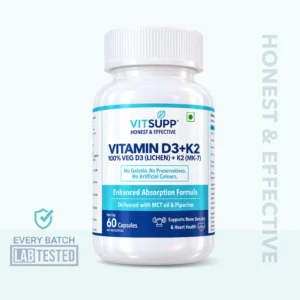
Its well-researched formulation contains lichen-based Vitamin D3, Vitamin K2 MK-7, MCT oil, and piperine extract standardized to 95%. Also, the supplement undergoes extensive third-party lab testing to ascertain safety and meet RDA requirements.
A Look at Components Used in VitSupp Vitamin D3 + K2 Formula
| Ingredient | Role in VitSupp Vitamin D3 + K2 Formula | Why It Matters |
|---|---|---|
| Lichen-Based Vitamin D3 (Vitashine) | Uses Vitamin D3 (cholecalciferol) from a vegan source | Vitamin D3 is the form commonly used in supplements to support Vitamin D intake |
| Vitamin K2 MK-7 (BioEssence) | Supports calcium utilization within the body | Helps complement Vitamin D’s role in calcium metabolism |
| MCT Oil | Offers a fat-based delivery system | Vitamin D is fat-soluble, so dietary fat and formulation design can affect its absorption |
| Piperine Extract 95% | Supports the bioavailability approach of the formulation | Has the ability to affect the availability of selected compounds through absorption and metabolism pathways |
Safety and Medication Considerations
Piperine has a potential role in enhancing the bioavailability of specific compounds. Research indicates that piperine may interact with transport proteins and metabolic enzymes involved in the movement and breakdown of some compounds. However, the same biological pathways can also affect how the body processes certain medicines.
- So, consult a healthcare professional before taking supplements with concentrated piperine extracts if you take regular medications.
- As with any supplement, the recommended serving size matters. Check the percentage of piperine in the supplement.
- Pregnant or nursing individuals, people with existing medical conditions, or those taking medication should seek medical guidance before use.
VitSupp’s Vitamin D3 + K2 label includes these precautions and mentions the need for a professional consultation in such situations.
This Vitamin D3 and K2 supplement stands on solid grounds as far as safety is concerned. It is a clean-label, vegan-friendly supplement, manufactured in an FSSAI-licensed and GMP-compliant facility. The formulation is devoid of any gelatin, lanolin, gluten, soy, dairy, preservatives, or any unnecessary ingredients.
Conclusion
Piperine remains an interesting supporting ingredient in vitamin D3 formulations. The human evidence is strongest for compounds like curcumin and Coenzyme Q10. For vitamin D, it is still in the developmental stage.
However, its role in supporting bioavailability makes formulators include it. As more vitamin D-specific studies emerge, its role will get solid backing.
This is precisely why VitSupp chose it for its Vitamin D3 + K2 – a 600 IU dose of Vitashine D3 and BioEssence K2 MK-7. The vegan supplement, coming with 95% standardized piperine extract and an MCT oil base, is made with research-backed ingredients. You will not find any unnecessary ingredients, only cofactors that support absorption and overall objectives.
FAQs
1. What is piperine, and what are its health benefits?
Piperine is a natural alkaloid found in black pepper, which gives it a characteristic pungency. Its role as a bioavailability enhancer has been the subject of studies. Human studies have shown that piperine can increase the bioavailability of compounds such as curcumin and Coenzyme Q10 under specific conditions. Piperine benefits also include antioxidant and anti-inflammatory properties. However, many findings require further human studies. It works more as a supporting compound rather than a nutrient itself.
2. How does piperine improve nutrient absorption?
Piperine may support nutrient bioavailability by affecting the absorption of specific compounds in the human body. It also has a role in the transportation and metabolism of those compounds. Research indicates that it may affect intestinal transport proteins such as P-glycoprotein and enzymes involved in metabolism, including CYP3A4. Human studies have shown increased bioavailability of specific compounds, including curcumin and Coenzyme Q10, when used with piperine. For Vitamin D, piperine may play a supporting role within a formulation. Direct human evidence showing higher Vitamin D absorption is limited.
3. How does piperine work in the body?
Piperine is a compound naturally found in black pepper. Several studies point to its role in supporting the bioavailability of certain compounds. It may influence processes in absorption and metabolism, including intestinal transport proteins. It may increase the availability of specific compounds when you consume them together. However, piperine’s health benefits also depend on the compound, dosage, and formulation. Piperine serves as a supporting ingredient that may influence how certain substances get processed in the body. It does not work as a universal absorption enhancer.
4. Does piperine help absorb vitamins?
Piperine may support the bioavailability of certain compounds. However, it does not support the absorption of every vitamin similarly. Research has mostly focused on specific nutrients and bioactive compounds, and some fat-soluble compounds.
For Vitamin D, human trials showing that piperine supports better absorption are awaited. Vitamin D absorption depends on several factors, including its fat-soluble nature, dietary fat intake, and the overall formulation. Piperine may serve as a supporting ingredient in some Vitamin D formulations. Think of it as part of the formulation rather than the only factor influencing absorption.
5. How does piperine increase bioavailability?
Piperine in supplements may help enhance the bioavailability of specific compounds in the human body. It affects the processes controlling their absorption and breakdown in the body. Research shows that piperine can affect intestinal transport proteins, like P-glycoprotein, and enzymes involved in metabolism, including CYP3A4. These interactions may enable some compounds to remain in the bloodstream for longer.
Human studies have shown that piperine helps support the bioavailability of specific compounds. But these effects are largely compound-specific. Piperine may not increase the absorption of every nutrient or vitamin in the same way.
6. Is piperine safe to consume daily?
Piperine is generally safe when you consume it in the amounts typically found in foods. In supplement form, concentrated piperine extracts should be used according to the recommended dosage. It may influence enzymes and transport proteins involved in processing certain substances. Therefore, it has the potential to affect how the body absorbs or metabolizes certain medications. In particular, those taking regular medicines, pregnant or nursing women, and those with chronic conditions should consult a healthcare professional before taking a supplement with concentrated piperine.
The safety of piperine also depends on the dose and the entire formulation. The effect of small amounts naturally consumed through culinary black pepper is not similar to a standardized extract in a supplement.
7. Can piperine help with inflammation?
Piperine has undergone studies for its potential anti-inflammatory properties. Studies indicate that piperine may affect inflammatory pathways and molecules involved in the body’s inflammatory response.
However, the strongest evidence on piperine’s health benefits for inflammation comes from preclinical research. More human studies are necessary to understand its practical effects. It is not a solution for treating inflammatory conditions.
When used in supplements, piperine may support absorption of certain nutrients. Its presence in the formulation may help improve the availability of selected compounds in the body.
8. Can piperine improve Vitamin D absorption?
Piperine may support the bioavailability of certain compounds. Human studies show that piperine can support the availability of specific compounds by affecting the absorption and metabolism processes. However, these findings do not directly apply to Vitamin D, since different nutrients follow specific absorption mechanisms.
Vitamin D is fat-soluble. Research shows that taking it with a meal containing healthy fats can help improve its absorption. It would be prudent to think of piperine as a supporting ingredient in a Vitamin D formulation, not a standalone nutrient enhancer.
9. Should you choose a Vitamin D3 supplement with piperine?
A Vitamin D3 supplement with piperine can be one option worth considering. But it is ideal not to choose a formulation based only on the compound. When checking out a Vitamin D3 supplement, focus on factors affecting vitamin D absorption, the form of Vitamin D3, ingredient transparency, dosage, quality testing, etc. The supporting ingredients should have a clear purpose, too. As the vitamin is fat-soluble, taking it with a meal containing fat may also support absorption.
A well-designed formulation should have purposeful ingredients rather than simply adding more components.
10. Why is piperine added to Vitamin D3 supplements?
Piperine is added to some Vitamin D3 supplements as research data indicates its role as a bioavailability enhancer. Studies suggest that piperine may affect how certain compounds get absorbed, transported, and metabolized in the body.
However, piperine’s role in Vitamin D formulations needs detailed and careful evaluation. Vitamin D absorption depends on many factors other than the presence of a specific ingredient. Therefore, it would be prudent to view piperine as a supporting component within a carefully designed Vitamin D3 formulation.