
Amidst all the facilities and amenities of urban life, we often overlook health, unknowingly. It’s not only about a sedentary lifestyle or relying on junk foods. Unconsciously, you may develop magnesium deficiency, like many others. The Indian Journal of Medical Research findings show that over 75% of urban Indians suffer from this nutritional deficit.
Magnesium deficiency can develop slowly. Not many are aware that magnesium and gut health are deeply linked. As you spend long hours indoors, coping with pollution and limited sunlight exposure, it negatively affects your metabolism. Digestive issues like constipation, bloating, and irritable bowel syndrome crop up, but the root issue is magnesium deficiency.
Stop looking for temporary fixes like fiber supplements or laxatives. The solution often is in the body’s mineral reserves. Just taking any magnesium supplement will not be enough; you need the right and safe type of magnesium for digestion. Choose the form that supports digestive flow, improves gut health, and reduces symptoms like constipation.
VitsUpp’s Magnesium Bisglycinate lets you overcome several digestive challenges without any risk or complications.
In this blog, we’ll explore how magnesium contributes to a healthy gut, the link between urban life’s impact on magnesium, and compare the various forms of magnesium for digestion. You will find out the missing link between digestive health and magnesium.
Magnesium for Digestion: The Key Mineral You Need
When looking for healthy foods and supplements, you may have overlooked Magnesium. But this essential mineral plays a role in over 300 biochemical processes in your body. From maintaining heart and bone health to supporting muscle function, it acts with amazing versatility. Despite its importance, between 10% and 30% of the population suffers from its deficit, even in developed countries. The urban populations remain particularly vulnerable.
Magnesium regulates many physiological functions in your body- including supporting nerve function, controlling blood sugar levels, and turning food into energy. Besides, magnesium intake helps in muscle relaxation. That’s why its deficit may cause cramps and spasms in the digestive tract.
Magnesium and gut health are deeply linked. This key mineral helps maintain gut motility, supports regular bowel movements, and lowers digestive discomfort. Magnesium helps relax the muscles in your digestive tract, so that you do not face issues like constipation, cramps, or bloating.
Magnesium Deficiency: The Hidden Epidemic Affecting Your Digestion
A deficiency in magnesium is more common than you think, and the symptoms are pretty wide-ranging. You can experience headaches, muscle cramps, or fatigue frequently when your body does not get its daily amount. Magnesium deficit affects almost every system in your body. However, its role in the digestive system is often overlooked.
When your magnesium levels are low, you will experience symptoms like:
- Constipation – Without enough magnesium, the muscles of the digestive tract remain stiff, impairing smooth bowel movements. The result is constipation.
- Gut discomfort – Magnesium is crucial for digestive comfort; low levels add to recurring bloating and cramping. Those with conditions like irritable bowel syndrome (IBS). fare worse.
- Poor nutrient absorption – Without sufficient magnesium, your body will struggle to absorb nutrients from food, further affecting gut health.
You can’t entirely avoid the downsides of an urban lifestyle, including rising stress, pollution, lack of healthy meals, sedentary work environments, etc. These, coupled with magnesium deficiency, can add to recurring and annoying digestive issues.
It’s time you understand the link between Magnesium and gut health and start taking the right supplement to fulfill the deficit. Try Magnesium Bisglycinate by VitSupp, the ideal magnesium for digestion, made with safe and effective ingredients, for a digestive and overall health boost. You won’t experience a strong laxative effect or digestive discomfort, often caused by other forms of magnesium.
How Magnesium Regulates Your Digestive Health?
Magnesium acts as the silent regulator of your gut health, even though people associate it mostly with other physical functions like bone health, muscle relaxation, or heart function. It helps keep bowel movements regular, and a deficit may add to numerous gut health issues.
How Magnesium Improves Gut Motility
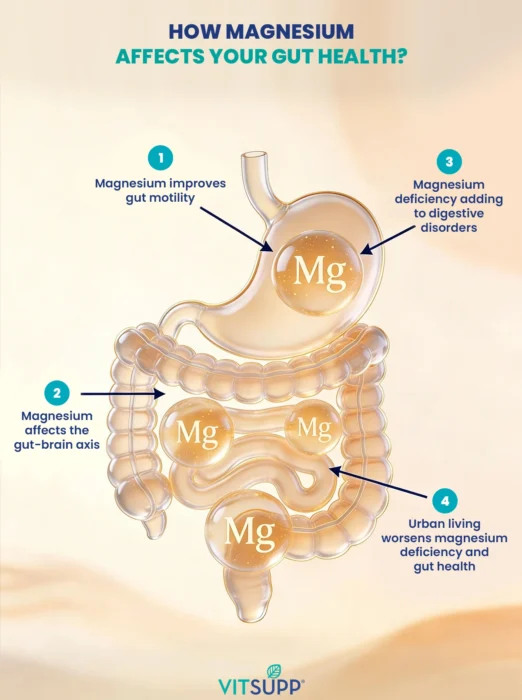
Magnesium helps relax muscles in your body, including the gut tract cells. When the gut muscles are relaxed, food and waste move smoothly through your intestines. This is more important in the large intestine, where water retention is important.
Magnesium also has a mild laxative effect on the body. However, you will find most health brands using the form magnesium citrate. However, for a gentler effect on your guts, the best option is using magnesium bisglycinate. That is exactly what you get in VitSupp’s offering. It does not cause a strong laxative effect while helping reduce constipation and gut discomfort.
Magnesium and the Gut-Brain Axis
Not many people think about the gut-brain axis, the connection between the digestive system and the brain. Here, magnesium plays a crucial role, and its deficit can impair this connection. When that happens, you cope with stress, anxiety, and other emotional imbalances. These can hurt your digestive system functions, too.
People with digestive conditions like IBS face symptom flare-ups with excess stress. Magnesium is often called the “anti-stress mineral” because it helps calm the nervous system. That lets your body manage stress better, contributing to an improved gut. With the right Magnesium supplementation, your gut bacteria balance is restored.
Magnesium Deficiency and Digestive Disorders
A deficit in Magnesium and gut health disorders are interlinked. Specific digestive disorders like Crohn’s, celiac disease, or chronic diarrhea reduce your body’s capacity to absorb this mineral from foods. On the other hand, low magnesium adds to issues like constipation, nausea, and poor appetite.
Think of it, this acts like a double blow to your gut health, and how? Lack of enough magnesium may trigger poor gut motility and digestive problems, which can cause further loss. These, combined with the urban living limitations like stress and lack of sleep, can worsen the situation.
How Urban Living Worsens Magnesium Deficiency and Digestive Health?
In urban settings, magnesium deficiencies are becoming more commonplace. Stress and sedentary lifestyles affect your gut functions adversely. Additionally, high pollution levels reduce magnesium absorption by affecting your body’s Vitamin D synthesis ability. Increased indoor living, long working hours, and less sun exposure may add to recurring magnesium deficiency.
Do these sound familiar? It’s time you begin using VitsUpp’s Magnesium Bisglycinate, a safe and effective magnesium supplement with enhanced bioavailability, that is gentle on the gut. Unlike products containing magnesium citrate or sulfate, it does not cause side effects and helps reduce gut health issues.
Understanding gut-friendly magnesium is just the start. Discover how magnesium supports muscle, nerve, and metabolic health in our complete guide: Know Magnesium: The Essential Mineral and Nutrient.
The Different Forms of Magnesium and Their Effect on Digestion
Magnesium comes in various forms, but not all are suited for gut health. You must learn which form is ideal for your digestive system and why.

1. Magnesium Citrate
Useful for relief in constipation, this form of magnesium has a laxative effect on the body. It draws water into the intestines, softening stools and easing bowel movements. However, for those with sensitive stomachs, it may cause discomfort.
2. Magnesium Bisglycinate
A gentle and bioavailable form, Magnesium bisglycinate does not irritate your intestines. It reduces constipation and improves gut health, without any risks.
3. Magnesium Malate
Magnesium malate, which is a mix of malic acid and magnesium, is ideal to bring relief in muscle cramps and fatigue, and it also offers better gut motility. It works well on those with chronic gut cramps and discomfort, or conditions like IBS.
4. Magnesium Taurate
This form blends magnesium with taurine and is especially good for heart health and blood pressure. It also offers digestive comfort.
5. Other Forms
You can also find other variants of magnesium for digestion, including Magnesium sulfate and magnesium oxide. The former is good for muscle relaxation, and the latter has a laxative effect but is not gentle on the gut.
| Form of Magnesium | Primary Benefits | Digestive Impact | Best For | VitsUpp Advantage |
|---|---|---|---|---|
| Magnesium Citrate | Laxative effect, draws water into the intestines | Effective for constipation relief, it may cause discomfort for sensitive stomachs | Short-term constipation relief | Not ideal for long-term use |
| Magnesium Bisglycinate | Highly bioavailable, gentle on the stomach | Supports gut motility, constipation relief, and aids healthy digestion | Gentle, long-term digestive support | Maximum absorption, gentle on the digestive system |
| Magnesium Malate | Combines magnesium with malic acid for muscle relief | Improves gut motility, reduces fatigue and pain | Chronic pain or IBS patients | Great for muscle cramps and digestive health |
| Magnesium Taurate | Mixes magnesium with taurine for heart health | Brings digestive comfort, supports heart health | Heart health and digestive issues | Supports heart and digestive balance |
| Magnesium Oxide | Commonly used for its laxative effect | May cause digestive woes, lower absorption | Short-term constipation relief | Not ideal for sensitive stomachs |
| Magnesium Sulfate | Muscle relaxation, often used with Epsom salts | Mainly used for muscle relaxation rather than digestion | Muscle pain relief and detoxification | Not primarily for digestive health |
To overcome the combined effects of urban stress, a poor diet, and digestive issues, VitsUpp’s Magnesium Bisglycinate supplement is a suitable option. One capsule a day keeps your gut healthy while bringing you additional health benefits.
How Magnesium Deficiency Affects Gut Health in Multiple Ways?
Magnesium is a key mineral that affects more than just muscle function and bone health in your body. You need magnesium for digestion without discomfort and chronic hassles. When you don’t get the required amount of magnesium, you cope with several digestive conditions, which recur and aggravate.
1. Constipation
Low magnesium intake may add to constipation. Why? Magnesium relaxes your gut tract muscles, and this contributes to smooth bowel movement. When magnesium levels are low, the intestinal muscles become tense, adding to slower digestion and irregular bowel movements.
2. Bloating
Magnesium regulates the fluid balance within the intestines. So, its deficit may trigger excess water retention. You deal with bloating and discomfort.
3. Irritable Bowel Syndrome (IBS)
Magnesium deficiency exists in a lot of people coping with digestive disorders like IBS. Research indicates that low magnesium levels can worsen IBS symptoms.
When you deal with such digestive issues, the root cause can be a shortfall in magnesium intake. But using just any supplements will not be useful. Go for a balanced supplement for effective and lasting relief from several digestive health woes.
How to Choose the Ideal Magnesium Supplement for Digestive Health?
In a market flooded with multiple magnesium supplements, how do you pick the one that contains the right form of magnesium for digestion? You need a solution that fulfills your magnesium deficiencies and brings desired benefits without risks.
Listed here are factors that you should use to compare and choose an apt magnesium supplement:

1. Bioavailability
Magnesium bioavailability refers to how easily your body can absorb and utilize magnesium from a supplement. Among various types of magnesium, Magnesium Bisglycinate is known for its high bioavailability.
2. Digestive Sensitivity
Choose a magnesium supplement carefully when you have a sensitive stomach. The variant used must be gentle on your guts. That is why you should choose VitsUpp’s offering, with Magnesium Bisglycinate, which comes without any filler.
3. Laxative Effect
Stop reaching for OTC laxative products when you have better alternatives. Different forms of magnesium, like magnesium citrate and magnesium sulfate,e work well here. However, they are not as gentle on your system as Magnesium Bisglycinate.
4. Effective Ingredient
Even when you seek magnesium supplementation for gut health benefits, check for the type used. Try a Magnesium supplement with Magnesium Bisglycinate for desired efficacy.
Why VitSupp Magnesium Supplement is the Right Choice for you?
You need a magnesium supplement that not only resolves digestive woes but also ensures the synergy between the gut and brain is improved. With multiple forms like oxide, citrate, and blended “glycinate” products, most people are left guessing what they’re actually taking — and whether it’s suitable for daily use.
VitSupp Magnesium is designed to simplify that decision.
Unbuffered VitSupp Magnesium Bisglycinate Chelate not only fulfills your magnesium deficiencies, but also packs in additional health benefits- while keeping you safe. Here’s how:

1. A Single, Clear Form of Magnesium Bisglycinate
VitSupp uses magnesium bisglycinate chelate, one of the most preferred forms for those looking for a clean and well-tolerated magnesium supplement. There are no blends, no mixed salts, and no hidden ingredients. Just one clearly defined form – making it easier to understand and trust what you’re taking. If you’re searching for magnesium bisglycinate in India, clarity matters – and that’s exactly what this formulation delivers.
2. Unbuffered and Oxide-Free Magnesium
Many products marketed as magnesium glycinate are often buffered with magnesium oxide, a lower-cost form commonly used in supplements. VitSupp takes a different approach.
This is a completely oxide-free magnesium supplement, formulated as:
- Non-buffered magnesium bisglycinate
- No magnesium oxide or mixed forms
- Fully transparent ingredient declaration
- That means you’re getting exactly what the label says – nothing diluted, nothing hidden.
3. Designed for Daily Use and Digestive Comfort
Not all magnesium supplements are designed for consistent, everyday use.
VitSupp Magnesium is created with a focus on:
- Gentle digestion
- Daily tolerance
- Routine-friendly supplementation
- For those looking for a magnesium supplement for daily use, this formulation keeps things simple and practical.
4. Clean, Minimal, and Transparent
As a clean-label magnesium supplement in India, VitSupp follows a minimal formulation approach:
- No artificial colours
- No preservatives
- No unnecessary additives
- 100% vegetarian HPMC capsules
- Every ingredient is included for a reason – nothing more.
5. Made for People Who Want Clarity, Not Confusion
If you’ve been comparing multiple magnesium supplements in India and still feel unsure which one to choose, you’re not alone.
VitSupp is built to solve that problem. Instead of multiple variants, you get one well-designed, oxide-free magnesium bisglycinate supplement – created for people who value simplicity and transparency.
6. A Smarter Way to Choose Magnesium
VitSupp Magnesium is not positioned as a quick fix or a high-dose solution. It’s a clean, unbuffered magnesium bisglycinate supplement, designed for clarity, consistency, and long-term use.
Because when it comes to your health, you don’t need more options – you need the right one.
7. Soothes your Stomach
This Magnesium Bisglycinate has a formulation that enhances absorption without being harsh on your gut tract. It is gentle and promotes long-term digestive support.
8. Promotes Better Digestion
Its bioavailable form of Magnesium acts as a muscle relaxant and relaxes the muscles of the digestive tract. You experience better and smoother bowel movements and effective relief from constipation.
9. Great for Urban Users
You can’t escape the consequences of living in a hectic urban environment, including stress, pollution, and a sedentary lifestyle. All these affect your gut health and lead to magnesium deficiencies. You can fight back with VitSupp Magnesium Bisglycinate, a supplement offering multifaceted health benefits.
10. No Allergens and Fillers
Unlike run-of-the-mill supplements, VitSupp’s offering does not contain any chemical or harsh ingredients that can affect your gut health. In it, you will not get any trace of gelatin, gluten, soy, talc, etc. Neither does the formulation contain any preservatives like titanium dioxide, artificial colors, or flavors.
11. One Simple, Easy-to-Use Supplement
VitSupp offers you the best magnesium supplement in India, without the confusing variants. No need to compare different flavors or options; you get a simple, easy-to-use supplement in capsule form. You get a highly bioavailable form of magnesium for digestion, packed in a simple-to-use capsule.
12. Quality Assurance
You get a study-backed formulation for Magnesium intake with the assurance of GMP and FSSAI. This offers assurance about manufacturing standards and purity.
Conclusion
Magnesium and gut health are deeply related, the lack of mass awareness notwithstanding. This key mineral aids in digestion, regulates bowel movement, and plays many other functions. Low magnesium intake can add to several digestive issues, like constipation, bloating, and intestinal discomfort. It can be especially tough if you are coping with conditions like IBS.
Living in urban setups with limited sun exposure, stress, and pollution can aggravate magnesium deficiency. This, in turn, can add to digestive woes. You need a quality magnesium supplement based on bioavailable forms like Magnesium Bisglycinate. VitSupp Magnesium Bisglycinate supplement ticks all the boxes here with its safe, effective, and GMP-certified formulation.
The supplement ensures optimal absorption and chelated magnesium benefits while being soothing on your stomach. It supports gut health and regulates bowel movements.
Try the VitSupp Magnesium supplement to deal with your digestive discomfort and magnesium intake deficit, and enjoy a better mood and immunity, too. Suitable for adults with a sedentary lifestyle and those coping with urban lifestyle-related gut health issues, this supplement is also ideal for vegetarians.
FAQs
1. What is the hidden link between digestion and magnesium?
Magnesium plays a crucial role in digestionin your body. It regulates the muscles of the digestive tract and facilitates smooth bowel movements. The mineral helps relax the muscles of the intestines, allowing the food and waste to pass through without hassles. This essential mineral also helps maintain the right water balance in the intestines, thereby reducing constipation. Magnesium deficit may add to sluggish digestion and bloating and can aggravate IBS. Research indicates that magnesium helps maintain the gut-brain, which is key for digestion and mental well-being. Your body needs magnesium for digestion, but you have to get the right form.
2. Does magnesium deficiency affect gut health?
Yes, magnesium deficiency directly affects your gut health. It can also add to existing or chronic digestive health conditions like IBS. Magnesium is a prerequisite for digestive motility, as it helps relax the muscles of the intestinal walls. When you cope with a magnesium intake deficit, the results are constipation, bloating, and abdominal discomfort. Besides, magnesium deficiency can disrupt the gut microbiome. To get rid of magnesium deficiencies, you should consume a quality supplement in forms like magnesium bisglycinate.
3. Why does digestion affect magnesium absorption?
Digestion plays a major role in magnesium absorption, as magnesium and gut health are interrelated. This key mineral is primarily absorbed in the small intestine. Health conditions like IBS and Crohn’s disease can hurt your intestinal lining, affecting its functions. In turn, your body’s capacity to soak in magnesium takes a hit. Harmful gut bacteria also affect magnesium absorption, which is the case with people coping with chronic digestive conditions. If you drink alcohol regularly or follow high-fiber diets, that can slow down magnesium’s absorption. Modifying your diet and lifestyle, and taking a balanced Magnesium supplement offering will help.
4. How is magnesium absorbed in the gut?
Magnesium is absorbed mostly in your small intestine. Roughly, 30-50% of ingested magnesium gets absorbed into the bloodstream. This process is regulated by the body’s magnesium levels. When your body’s magnesium levels are low, the absorption process is affected. Additionally, magnesium absorption is affected by additional factors like stomach acid, dietary fat, and intestinal health. When your body gets the required amount of vitamin D from food or sunlight, its magnesium absorption capacity increases. However, gut inflammation or poor digestive health can reduce magnesium intake, adding to deficits.
5. What is the best magnesium for sensitive stomachs?
If you have a sensitive stomach, the ideal form of magnesium you should take is magnesium bisglycinate. Among all types of magnesium, it is said to be the most gentle on the gut. Unlike variants like magnesium citrate or magnesium oxide, it won’t cause any digestive discomfort. It also has a high absorption rate. As it doesn’t exert a strong laxative effect on your body, you can safely take it regularly. It can be ideal for people coping with IBS, acid reflux, or other conditions that make digestion sensitive.
6. How do gut-friendly magnesium forms like bisglycinate actually work?
Gut-friendly magnesium forms like bisglycinate do not irritate the stomach or intestines, to begin with. Magnesium bisglycinate is a chelated form of magnesium, where magnesium is bound to glycine, an amino acid. This helps reduce the risks of digestive discomfort. Using magnesium sulfate or citrate can irritate your stomach or cause digestive upset. However, the bisglycinate form relaxes the smooth muscles of the digestive tract, enhancing bowel movements. There is no strong laxative effect or discomfort. This makes the form of magnesium ideal for people with sensitive stomachs or those suffering from digestive disorders like IBS or acid reflux.
7. Are chelated magnesium supplements easier to digest?
Yes, chelated magnesium supplements are generally easier to digest than other types of magnesium. In chelated forms, magnesium is bound to an amino acid or another molecule. This makes the mineral more bioavailable and easier to absorb. Magnesium bisglycinate is one example, and it is gentle on the gut. Unlike magnesium oxide or sulfate, it won’t cause gas, bloating, or diarrhea. The chelation process helps protect magnesium from interacting with other compounds in the gut. This ensures less irritation and adds to better absorption. So, you can use chelated magnesium for digestive comfort while boosting your magnesium levels.
8. Can magnesium supplements actually help improve gut health and leaky gut?
Yes, magnesium supplements can help improve your gut health. When you choose the right form of magnesium, it can help manage conditions like leaky gut. Magnesium helps your body maintain a healthy intestinal barrier. Its deficit can affect digestive tract health badly, allowing toxins and undigested food particles to get into the bloodstream. Studies indicate that using magnesium supplementation can help reduce gut tract inflammation and promote gut motility. However, you must choose a safe, balanced magnesium supplement containing forms like magnesium bisglycinate.
9. What is the best magnesium supplement for digestion in India?
In India, Magnesium Bisglycinate is considered the ideal magnesium supplement for digestion due to its high bioavailability and gentle effect on gut health. Unlike magnesium citrate or oxide, types of magnesium that can irritate the stomach, it works in a synergistic way. This variant is ideal to support gut motility and regular bowel movements. You will be able to gain the benefits even when you have digestive conditions like acid reflux or IBS. VitsUpp Magnesium Bisglycinate supplement is a balanced, versatile supplement that brings you solid gut health benefits and more. It is well-suited for people coping with urban lifestyle limitations, including magnesium deficit and chronic gut issues.
10. What are the primary benefits of switching to a chelated magnesium supplement?
By switching to a chelated magnesium supplement like magnesium bisglycinate, you can gain several health benefits, including a better digestive system. It is bioavailable and gentle on the digestive tract. Here, the magnesium is bound to an amino acid or another molecule. That helps improve its absorption efficiency, and your body is able to effectively absorb and use the mineral. It does not irritate the gut or stomach lining, unlike other types of magnesium. You won’t face the risk of diarrhea, bloating, and stomach cramps by using chelated magnesium for digestion. Additionally, chelated magnesium offers longer-term benefits, like better sleep and improved muscle relaxation.